
 Français



_11zon.webp)


_14_11zon.webp)
_6_11zon.webp)



Plasma Cutting vs. Fiber Laser Cutting: Which Process Is Right for Your Workshop?
- Nada Iddouch
- 13 Nov, 2025
- Oxy-fuel cutting
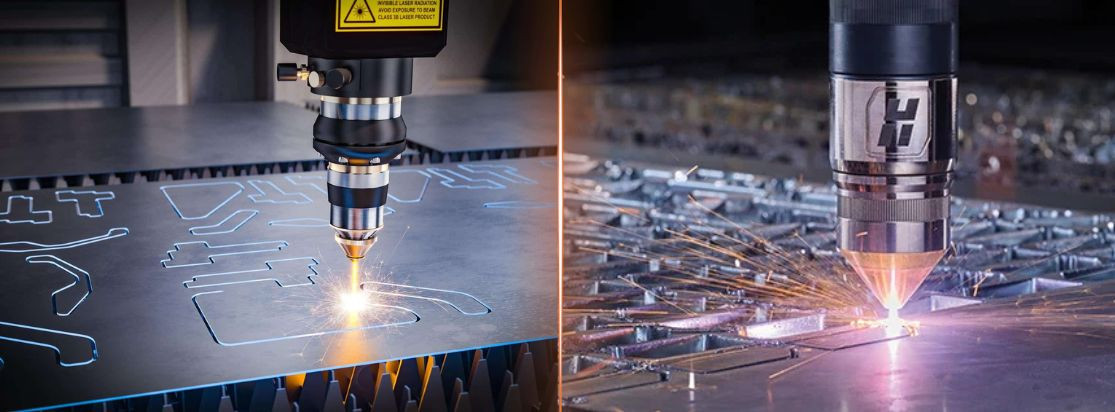
Efficiency and Applications of Plasma Cutting
Understanding How Plasma Cutting Works
Plasma cutting stands out as a preferred solution for processing electrically conductive metals. This technology uses ionized gas, heated and accelerated to high temperatures, which passes through a dedicated torch to generate an electric arc. Under the effect of this energy, the targeted material melts and is then rapidly expelled, allowing for a clean separation. Industrial sectors such as mechanical manufacturing, automotive, and construction widely use this process for its ability to deliver fast and precise cuts on materials like steel or aluminum.
The process can be carried out manually or through computer numerical control (CNC), making it suitable both for occasional needs and automated production lines where repeatability and accuracy are required. Combining a plasma torch with a CNC system allows machining of complex shapes while maximizing production flow efficiency.
Variants and Specificities of Plasma Cutting Techniques
Different approaches exist to leverage plasma depending on the technical requirements encountered in industry.
Conventional Plasma Cutting
The standard method involves an electric arc between a negative electrode and the workpiece, which is positively charged. It is suitable for most common industrial operations thanks to its robustness and versatility.
Precision Plasma Cutting
To achieve particularly fine results or meet tight tolerances, as required in the automotive or aerospace sectors, a more advanced version is used. The so-called “precision” cut produces a narrower kerf and delivers accurate profiling even on complex parts.
High-Definition Plasma
When edge quality must reach its highest level—minimal burrs, reduced bevel—high-definition plasma is an excellent choice. This technology relies on controlling the plasma arc to produce cuts with optimal finish quality.
Water-Injected Plasma Cutting
The controlled addition of water into the plasma jet offers several advantages: improved cooling of internal components (nozzle, electrode), significantly extended lifespan, and notable reduction of noise and harmful emissions. This technique is often used for materials sensitive to thermal deformation.
Dual-Gas Systems
To further improve performance on certain ferrous alloys—typically when working with steel—two gases are combined: one creates the plasma (usually nitrogen or compressed air) while the other (often oxygen) strengthens the chemical reaction to speed up the process and improve final cut quality.
Fine Plasma
Artistic work or small batch production sometimes requires extreme finesse. Here, a reduced nozzle paired with lower current provides rigorous control over every millimeter covered by the plasma jet.
Advantages of Plasma Cutting in Various Scenarios
Plasma cutting offers numerous advantages that explain its growing popularity among demanding professionals.
Suitable for Conductive Materials
All the variants mentioned above excel when cutting mild steel, stainless steel, aluminum, copper, or brass. The method remains reliable regardless of the metal type, as long as it conducts electricity sufficiently to initiate the arc required for localized melting.
Wide Range of Thicknesses
Unlike some technologies with a narrow optimal range, plasma systems perform well on both thin sheets and thick plates—even on sections over 16 mm, where they often outperform laser alternatives in cost and cut quality.
High Productivity Thanks to Speed
In environments where speed equals profitability—shipyards, high-volume mechanical workshops—this solution accelerates each operation and significantly reduces downtime between successive cuts.
Precision for Complex Shapes
Thanks to CNC advances and specialized nozzles, operators can perform multiple holes, intricate outlines, or customized patterns without sacrificing finish quality or requiring excessive post-processing.
Reduced Heat-Affected Zone (HAZ)
Limiting heat input locally greatly reduces warping or distortion—critical when processing fragile or dimensionally sensitive alloys. Water injection helps achieve this by quickly dispersing excess heat around the cutting path.
Clean Finishes
Another strong asset is the final appearance: clean edges with minimal or no burrs, reducing the need for grinding or deburring and saving time, labor, and materials.
Geometric Versatility
Whether cutting straight, beveling, piercing thick plates, or creating freeform shapes from CAD drawings supplied by clients, the machine remains highly versatile when properly configured.
Easy Mobility
Many machines are designed to be portable, allowing rapid on-site intervention (especially on construction sites) without heavy logistics or long preparation—an essential advantage when flexibility is required.
Simple Automation
Integration with industrial automation is straightforward; intuitive programming ensures optimal repeatability, suitable for demanding subcontracting as well as highly customized one-off projects.
Cost Control
Equipment is less expensive than many competing solutions; consumables are affordable; routine maintenance can be handled internally by trained staff. Overall, recurring investment is limited while maintaining high performance year after year.
Fiber Laser Cutting: Precision and Versatility
How Fiber Laser Cutting Works and Its Variants
Laser cutting relies on the extreme concentration of a focused beam of light that strikes the material and causes localized vaporization, enabling a clean separation achieved without contact.
The fiber laser is now the industrial standard thanks to major improvements over older CO₂ systems: better robustness, higher energy efficiency, simplified maintenance, and high adaptability to a wide variety of materials—from standard metals to advanced technical composites, and even some specialized plastics used in electronics, automotive, or aerospace applications.
The equipment mainly differs by output power:
- High power (> 1000 W): suitable for large production volumes requiring fast penetration through thick materials like steel or aluminum.
- Medium power (300–1000 W): balanced solutions covering a wide range of classic industrial applications.
- Low power (< 300 W): designed for high-resolution micro-cutting or detailed engraving of small parts.
- High-speed systems: specifically designed for thin sheet metal or plastics requiring high throughput with strict dimensional accuracy.
Optimal Conditions for Using Fiber Laser Cutting
Several situations highlight this technology particularly well:
- Multi-material compatibility: proven efficiency on reflective metals, light alloys, technical plastics, or advanced composites.
- Tight tolerances and fine details: ability to reproduce complex patterns with micrometric precision.
- Fast processing of thin sheets: optimal productivity for workshops focused on thin and medium thickness materials with short lead times.
- Task versatility: instant switching from cutting to marking or engraving through simple parameter changes, with no additional tooling.
- Minimal HAZ: strict thermal control limiting material deformation, even on very thin or heat-sensitive parts.
- Freeform shapes and complex geometries: easy adaptation to advanced CAD files for prototypes or specialized architectural or industrial design projects.
- Full automation: seamless integration into robotic lines, ensuring complete traceability for each production batch while minimizing repetitive human errors.
- Material savings: extreme precision reduces waste—an advantage for companies managing environmental costs or sourcing expensive or rare raw materials.
- No mechanical tool wear: no direct contact, avoiding frequent replacement of traditional cutting tools and reducing planned maintenance costs.
Comparison and Selection Between Plasma and Laser Cutting
Selection Criteria Between Plasma and Laser
| Criterion | Plasma Advantage | Fiber Laser Advantage |
|---|---|---|
| High thickness (>16 mm) | Yes | No |
| Thin metal / Complex details | Limited | Yes |
| Speed on large sections | Yes | Slower |
| Quality on thick materials | Excellent | Less consistent |
| Initial budget | Lower | Higher investment |
| Consumables | Moderate cost | Lower tool wear |
| Maintenance | Easy / in-house | Requires specialized technicians |
| Geometric versatility | Good | Excellent |
In summary:
To cut thick plates quickly (> 16 mm) while prioritizing robustness and reduced cost, the plasma solution is recommended.
For production requiring extreme finesse, strict tolerances, and multi-material processing, fiber laser clearly outperforms all alternatives.
Overall Economic Impact and Maintainability
Beyond technical capabilities, financial considerations remain decisive when choosing industrial equipment:
- Purchasing a fiber laser represents a significantly higher initial investment compared to an equivalent plasma machine.
- Extended amortization costs influence annual financial statements.
For thick or heavy materials, plasma consumables remain affordable, whereas the energy and gas consumption of a laser system increases rapidly, especially under intensive use. - Routine maintenance of plasma machines can be handled easily by trained in-house teams, while the slightest adjustment or major fault on a laser system requires intervention from a qualified technician.
- The longevity of high-end equipment ensures a satisfactory return on investment if production volume justifies the initial financial effort.
Setting up an efficient workstation requires a precise analysis of the specific needs of the workshop or project—whether it involves high throughput on massive plates using a robust mobile plasma system, or a pursuit of dimensional perfection using a latest-generation CNC fiber laser. To select the most suitable solution among these proven technologies, contact our welding/cutting experts to develop a personalized quote tailored to the specific requirements of your operation.
Let’s talk about your project
An industry expert will respond within 24 business hours.
Plasma cutting is a technique that uses heated ionized gas to create an electrical arc capable of cutting electrically conductive metals such as steel or aluminum.
Plasma cutting offers several advantages, including fast and precise cuts, a wide range of thicknesses handled, high productivity, and reduced heat-affected zones.
The main techniques include conventional plasma cutting, precision cutting, high-definition plasma, water-injected cutting, dual-gas systems, and fine plasma.
High-definition plasma provides maximum edge quality with minimal burrs, while precision cutting is used for exceptionally fine results and tight tolerances.
This technique involves adding water into the plasma jet to cool components, extend their lifespan, reduce noise, and lower harmful emissions.
Plasma cutting is effective on conductive materials such as mild steel, stainless steel, aluminum, copper, and brass.
The choice depends on the project’s specific needs: plasma is ideal for high thicknesses and lower budgets, while fiber laser is preferable for fine details and diverse materials.