
 Français



_11zon.webp)


_14_11zon.webp)
_6_11zon.webp)



2026 Guide: MIG vs TIG Welding - Differences & Cost
- Nada Iddouch
- 09 May, 2025
- Welding techniques
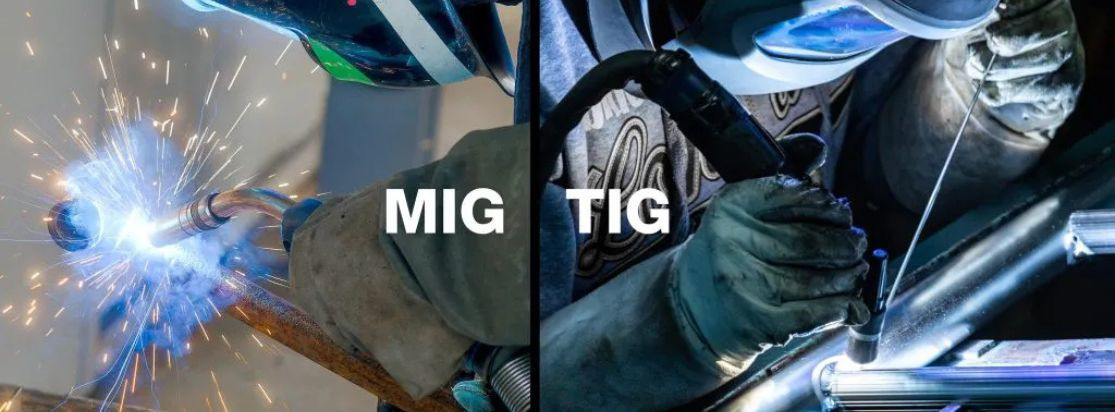
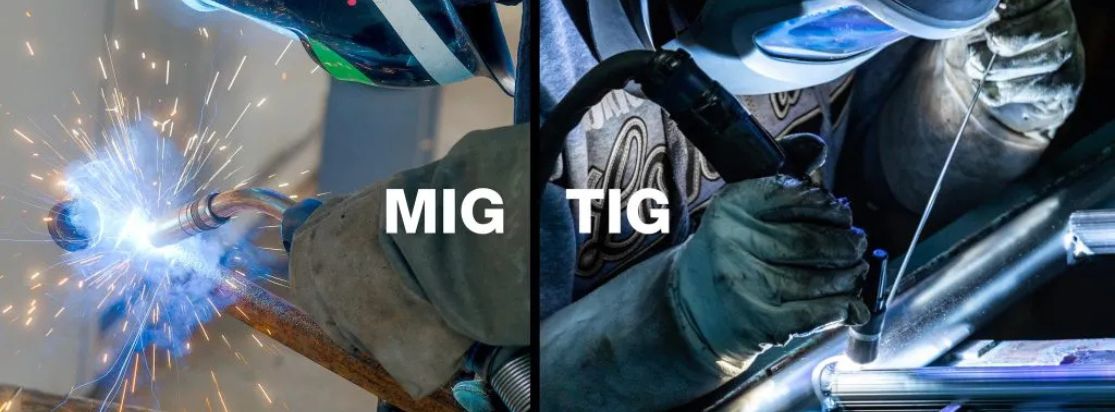
Welding is an essential technique in many industrial sectors, ranging from automotive construction to the fabrication of complex metal structures. Among the various welding methods, TIG welding and MIG welding stand out for their unique characteristics and specific applications. This comprehensive guide will help you understand the fundamental differences between these two techniques, their respective advantages, as well as their costs and efficiency in various industrial contexts.
I. Understanding the Basics of TIG and MIG Welding
TIG (Tungsten Inert Gas) welding and MIG (Metal Inert Gas) welding are two widely used arc welding processes in industry. While both methods aim to join metal pieces, they differ considerably in their implementation and results.
1. TIG Welding: Precision and Quality
TIG welding uses a non-consumable tungsten electrode to create the electric arc. This technique is characterized by its high precision and the exceptional quality of the welds it produces. The welder manually controls the addition of filler metal, allowing for fine control of the welding process.
TIG welding particularly shines in the following situations:
- Welding thin or low-thickness metals
- Work requiring impeccable aesthetic finish
- Assembly of heat-sensitive materials
- Performing welds on complex parts or in difficult positions
This method is particularly appreciated in the aerospace, luxury automotive industries, and for the manufacture of medical equipment, where precision and quality are paramount.
2. MIG Welding: Speed and Versatility
MIG welding, on the other hand, uses a consumable wire electrode that is automatically fed into the welding zone. This technique is distinguished by its rapid execution and versatility. MIG welding can be used on a wide range of metals and thicknesses, making it a highly sought-after solution in many industrial sectors.
The advantages of MIG welding include:
- High welding speed, ideal for mass production
- The ability to weld thick materials in a single pass
- Ease of learning and use for less experienced operators
- Adaptability to various types of metals, including steel, aluminum, and stainless steel
MIG welding is widely used in metal construction, automotive body manufacturing, and large-scale industrial production.
II. Detailed Comparison: TIG vs MIG
To better understand the differences between these two welding techniques, let's examine their respective characteristics in detail.
1. Weld Quality
TIG welding produces very high-quality welds, with unmatched precision. The weld beads are clean, neat, and require little or no finishing. This method allows precise control of weld penetration and minimizes metal deformation.
MIG welding, while capable of producing good quality welds, cannot compete with the finesse of TIG. MIG weld beads are generally wider and may require additional finishing work. Nevertheless, for many industrial applications, the quality of MIG welds is largely sufficient.
2. Speed and Productivity
In terms of speed, MIG welding far surpasses TIG. The semi-automatic nature of the MIG process allows for much higher welding speeds, which translates into increased productivity. This characteristic makes MIG the preferred choice for large-scale projects or those requiring rapid production.
TIG welding, on the other hand, is a slower process that requires particular attention from the operator. Each weld requires longer preparation and execution time, which limits its use in mass production contexts.
3. Versatility and Applications
MIG welding stands out for its versatility. It can be used on a wide range of metals, thicknesses, and in various welding positions. This flexibility makes it a suitable solution for many industrial sectors, from automotive construction to the fabrication of complex metal structures.
TIG welding, while less versatile in terms of materials and thicknesses, excels in specialized applications requiring extreme precision. It is irreplaceable for welding thin metals, heat-sensitive alloys, and work requiring perfect aesthetic finish.
4. Required Skills and Ease of Use
TIG welding demands a high skill level from the operator. Mastering this technique requires thorough training and significant experience. The welder must coordinate several actions simultaneously: controlling the arc, feeding the filler metal, and maintaining a constant distance between the electrode and the workpiece.
MIG welding, in comparison, is easier to learn and master. The semi-automatic process considerably simplifies the welder's task, allowing less experienced operators to produce acceptable quality welds after relatively short training.
III. Cost and Efficiency Analysis
Evaluating the costs and efficiency of TIG and MIG welding depends on several factors, including equipment, consumable materials, labor, and production volume.
1. Equipment Costs
TIG welding equipment tends to be more expensive than MIG, particularly for high-quality systems needed for precision applications. TIG machines often require more sophisticated components to ensure precise control of the arc and shielding gas.
MIG equipment, while less expensive initially, may require additional investments for specific applications, such as aluminum welding or the use of flux-cored wires.
2. Consumable Costs
Consumables for TIG welding (tungsten electrodes, filler metal rods, shielding gas) are generally more expensive than those for MIG. However, the consumption of these materials is often lower in TIG, which can balance costs over the long term.
MIG welding uses a continuous wire electrode, which can represent a significant cost in large-scale operations. Nevertheless, the speed of the MIG process often compensates for these costs through increased productivity.
3. Energy Efficiency
The energy efficiency of TIG welding is generally superior to that of MIG, particularly for thin materials. Precise control of heat input allows for minimizing energy consumption and metal deformation.
MIG welding, while less energy efficient for thin materials, can prove more efficient for thick materials due to its ability to deposit more metal in less time.
4. Productivity and Profitability
For large-scale projects requiring rapid production, MIG welding generally offers better profitability. Its high execution speed and ease of use translate into reduced labor costs and increased productivity.
TIG welding, while slower, can prove more profitable for projects requiring exceptional quality or involving expensive materials. The precision of TIG minimizes errors and rework, which can represent significant savings on high value-added parts.
IV. Choosing Between TIG and MIG: Factors to Consider
The choice between TIG and MIG welding depends on several key factors:
- Nature of the project: For precision work on thin materials or complex parts, TIG is often the best choice. For large-scale projects or those requiring rapid production, MIG will generally be more suitable.
- Type of material: TIG excels in welding sensitive metals like titanium or magnesium, while MIG is more versatile for steels and aluminum.
- Material thickness: TIG is ideal for thin materials (up to 6 mm), while MIG can effectively handle greater thicknesses.
- Required quality: If a perfect aesthetic finish or extreme precision is necessary, TIG will be preferable. For applications where standard quality is acceptable, MIG will suffice.
- Production volume: For mass production or large-scale production, MIG offers significant advantages in terms of speed and productivity.
- Available skills: If you have highly skilled welders, TIG can be exploited to its full potential. Otherwise, MIG may be a more practical option.
- Budget: Consider not only initial equipment costs but also long-term operational costs, including labor and consumables.
The choice between TIG and MIG welding is not a decision to be taken lightly. Each technique has its strengths and weaknesses, and the optimal choice will largely depend on the specifics of your project and production environment.
TIG welding remains unmatched in terms of precision and quality, making it indispensable for high-tech industries and applications requiring perfect finishing. MIG welding, with its speed and versatility, remains a pillar of large-scale industrial production.
In many cases, the ideal solution may be to have both technologies available, thus allowing to choose the most appropriate method according to the specific needs of each task. By understanding the nuances of these two techniques, you will be better equipped to make informed decisions and optimize your welding processes for the year 2025 and beyond.