
 Français



_11zon.webp)


_14_11zon.webp)
_6_11zon.webp)



Welding Simulation: Essential Tools and Key Challenges
- Nada Iddouch
- 15 Jan, 2026
- News and innovations
The Fundamentals of Numerical Simulation for Welding
Understanding Thermo-Mechanical Metallurgy (TMM) in Welding
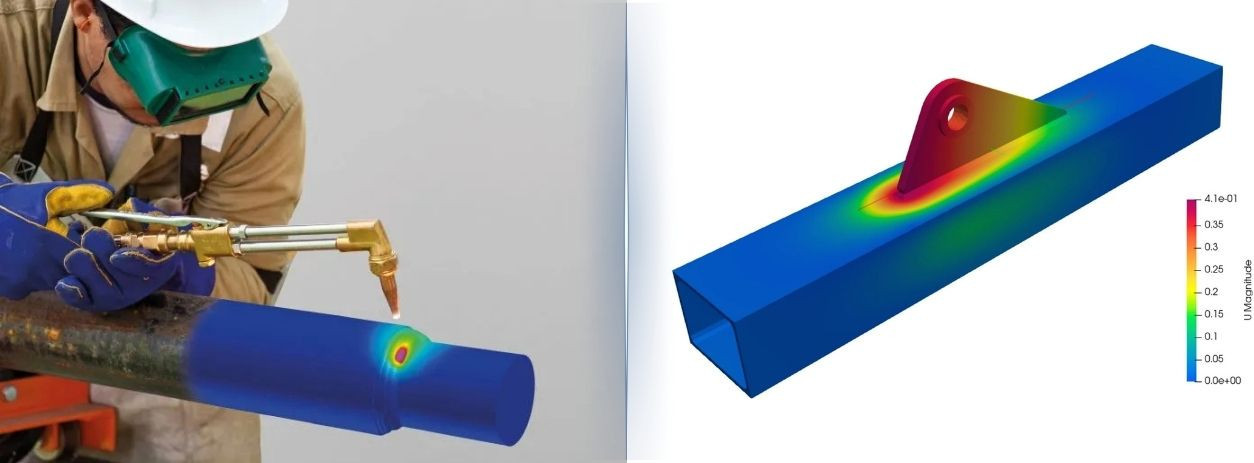
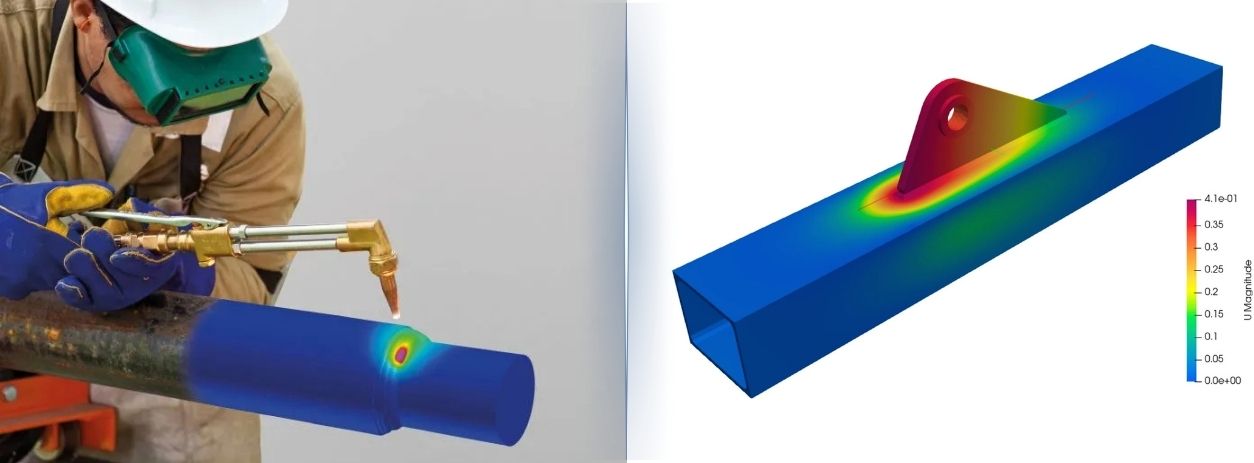
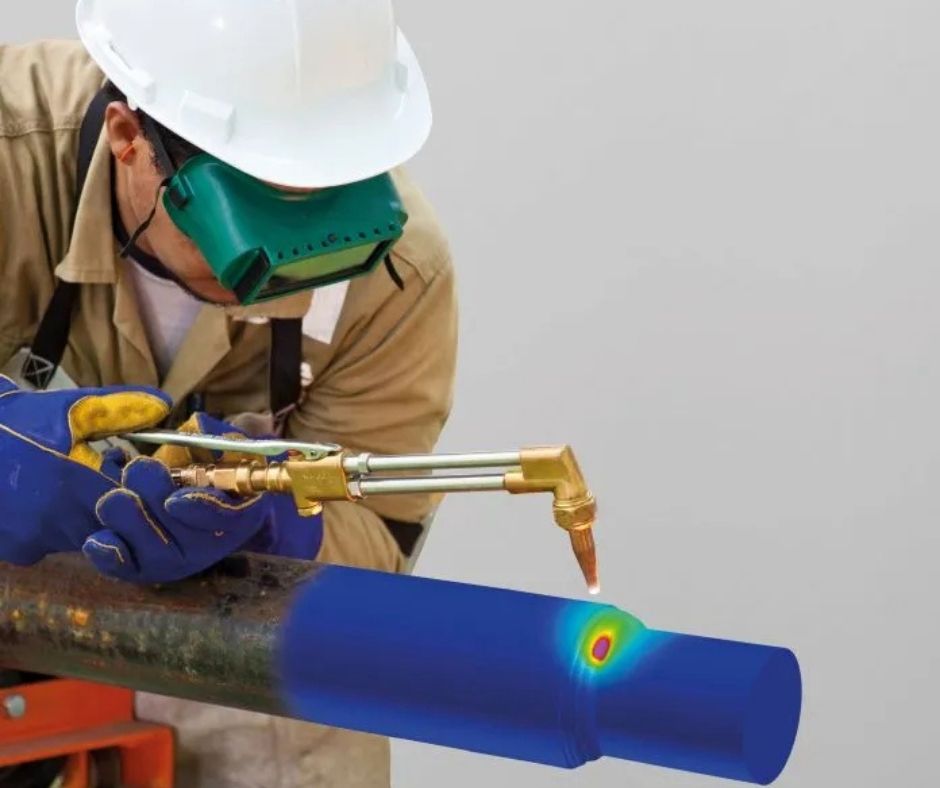
Numerical simulation applied to welding is based on complex thermo-mechanical and metallurgical principles. Its use consists of modeling the thermal and mechanical behavior of parts during the welding process. This numerical approach relies on mathematical models that integrate heat propagation, temperature variations within materials, as well as the internal transformations undergone by the metal.
When a welding operation is simulated, the first step is to solve a thermal equation in order to anticipate how heat diffuses through the workpiece. This calculation then makes it possible to evaluate phase transformations within the metal, a phenomenon triggered by exposure to high temperatures. Crystallographic changes and microstructure evolution directly influence the final mechanical properties of the joint.
The so-called TMM (thermo-mechanical metallurgical) method therefore combines these two aspects: it accounts for both thermal dissipation and the metallurgical consequences on the material. Thermo-mechanical analysis considers a wide range of parameters, such as interactions with tooling or the material’s behavior during cooling. Thanks to these advanced models, engineers can anticipate not only the final outcome but also potential defects related to internal stresses or deformations.
The earliest applications mainly involved simulating the thermal effects generated during welding, dating back to the 1940s. Since then, these approaches have evolved to incorporate increasingly refined modeling: consideration of the different heat-affected zones (HAZ), calculation of the proportions of metallurgical phases resulting from the thermal cycle experienced by each point in the material, and even prediction of crystallographic orientation or final grain size.
Today, this in-depth understanding goes far beyond simple thermal prediction: it provides a true technical decision-support tool to optimize every stage from design through to validation of welded assemblies.
Residual Stresses and Their Impact on Weld Durability
Welding operations inevitably generate residual stresses in assembled structures. These stresses arise mainly during rapid cooling following localized heat input; they can lead to angular distortions or unwanted movements within the joint.
Numerical simulation now enables precise determination of these stresses throughout the entire material volume concerned—including at mid-thickness, where they often differ significantly from surface values. This detailed analysis goes far beyond the empirical approach that assumes these stresses simply reach the yield strength of the metal used; in reality, their distribution varies with thickness or depending on whether the material has undergone post-weld heat treatment.
Engineers then use simulation results to validate whether an assembly will be able to withstand the mechanical loads expected during its service life. This approach can be combined with non-destructive testing methods: it becomes possible to determine the maximum allowable size of a detected defect in a given weld without compromising structural integrity.
In industrial practice, this methodology also makes it possible to anticipate certain classic problems such as:
- Localized buckling caused by excessive localized compression
- Angular distortions related to forming or twisting after cooling
- Uneven stress distribution leading to potential weaknesses in certain critical areas
The benefits do not stop there: thanks to a three-dimensional view obtained through simulation (often using symmetric half-models), it is possible to closely study each welding pass performed using different processes (TIG, MIG, plasma, etc.), in order to adjust sequencing and parameters to minimize distortions and dimensional losses as much as possible.
Finally, when multiple welds are required on the same complex structure—as is often the case in the aerospace or nuclear sectors—systematic use of these numerical tools is the only effective way to prevent unfavorable accumulations that would otherwise require planning costly operations later on, such as stress-relief heating or targeted mechanical straightening.
Optimization of Welding Processes Through Numerical Simulation
The Influence of Simulation on the Selection of Welding Parameters
The use of numerical tools profoundly changes the traditional approach, which was previously based mainly on a succession of physical trial-and-error tests carried out in the workshop. The possibilities offered by these software solutions are clear: virtually testing a wide range of parameter combinations before any actual production begins.
Each process has its own key variables: electrical current delivered to the electrode during arc welding, torch travel speed, applied power, and so on. All of these parameters can now be adjusted digitally in order to:
- Ensure strict compliance with technical specifications;
- Reduce the total number of experimental iterations required;
- Accelerate the development phase of new products;
- Avoid wasting rare or costly materials that may sometimes be difficult to source.
For example:
| Parameter | Effect analyzed via simulation |
|---|---|
| Current | Depth and fineness of weld bead penetration |
| Travel speed | Bead width and risk of undercut |
| Maximum temperature | Metallurgical phase transformations and extent of the HAZ |
In certain specific cases—when production lines are too frequently shut down due to isolated failures—the use of this analytical tool makes it possible to identify root causes and then correct existing machine configurations or processes in order to restore the robustness of continuous mass production.
This comparative principle also applies when evaluating two competing technologies intended to fulfill the same structural function: quickly comparing the expected levels of deformation depending on whether process A or B is selected makes it possible to choose the optimal solution without multiplying costly series of real physical tests.
This approach becomes even more relevant when working with precious metals, whose high cost prohibits the multiplication of unnecessary destructive tests.
It applies both to sectors where extreme quality requirements are paramount (high-end automotive, nuclear energy) and to fields facing specific challenges, such as large thicknesses in shipbuilding or the use of innovative alloys recently developed under environmental constraints.
Additive Manufacturing: A New Frontier for Numerical Simulation
The recent advent and rapid growth of additive manufacturing have given a decisive new impetus to digital techniques applied to welding. The continuous introduction of new alloys regularly calls into question the empirical knowledge previously accumulated regarding their behavior under intense heating regimes followed by rapid solidification.
This context makes extensive use of advanced computational modeling imperative, as it is capable of efficiently recalibrating each critical parameter in light of the unprecedented properties of modern materials—particularly those derived from recycling or specifically designed to meet the requirements of new generations of sustainable industrial products.
Here again, the central objective remains the drastic limitation of physical testing campaigns, which are particularly costly and intrusive when the volumes of prototypes available during the initial phases of industrial R&D laboratory work are limited. It is also worth highlighting the significant enrichment of the research community around topics such as topology optimization, artificial intelligence, and multidisciplinary coupling (for example, the integration of ultrasonic acoustic modeling dedicated to quality control).
Thanks to the synergy between computer-aided design, digitally optimized materials, and virtual validation of complete melting–solidification–cooling cycles, all stages are now better controlled, thereby accelerating the dissemination of innovative solutions across the market, in all sectors:
– Historic pioneering industries (automotive, nuclear, aerospace);
– New entrants driven by rapid innovation cycles, pricing competitiveness requirements, or small-series customized production.
This momentum benefits both from the software offering currently available—although still partially limited—and from the progressive upskilling of users, who are now trained in finite element simulation from the earliest stages of modern engineering curricula. Despite a still limited catalog of solutions specifically calibrated for welding effects and processes, the support of general-purpose tools, combined with deep domain expertise, is already producing tangible results among players heavily investing in the digitalization of industrial workflows related to complex metallic assemblies.
Summary and Industrial Perspectives
Numerical simulation profoundly transforms all aspects associated with modern welding: it enables precise anticipation of material behavior, a significant reduction in testing campaigns, and continuous improvement in process performance, whether traditional or emerging (notably additive manufacturing).
Its growing adoption addresses concrete needs for cost control, management of rare or difficult-to-source materials, and assurance of long-term structural integrity within strategic industrial sectors.
Although only a limited number of high-performance tools are currently available, their adoption—requiring dedicated training—delivers significant gains in overall efficiency across the entire cycle of innovation, production, and structural repair.
For any company seeking to optimize its operations, committing to greater digital mastery has now become an essential lever. Direct engagement with software and simulation specialists makes it possible to establish an accurate needs assessment and then provide tailored support toward sustainable industrial excellence.
Let’s talk about your project
An industry expert will respond within 24 business hours.
Numerical simulation in welding is the use of mathematical models to predict and analyze the thermal and mechanical behavior of components during the welding process. It makes it possible to model heat diffusion, metallurgical transformations, and residual stresses.
Numerical simulation offers several advantages, such as reducing physical testing, optimizing welding parameters, improving weld quality, and predicting potential defects.
Numerical simulation makes it possible to accurately determine the distribution of residual stresses within a welded structure, helping to prevent unwanted deformations and to ensure the long-term durability of assemblies.
Parameters such as electrical current, torch travel speed, and maximum temperature can be optimized to improve welding quality and reduce defects.
Numerical simulation is crucial in additive manufacturing because it enables modeling of heat effects and rapid solidification on new alloys, thereby reducing costly physical testing.
Sectors such as aerospace, nuclear energy, automotive, and shipbuilding benefit greatly from numerical simulation due to their high requirements for quality and structural safety.
It accelerates the development of new products by enabling virtual validation of processes, reducing the time and costs associated with physical testing, and encouraging the adoption of innovative technologies.