
 Français



_11zon.webp)


_14_11zon.webp)
_6_11zon.webp)



Spot Welding Guide: Techniques and Applications
- Nada Iddouch
- 02 Sep, 2025
- Welding techniques
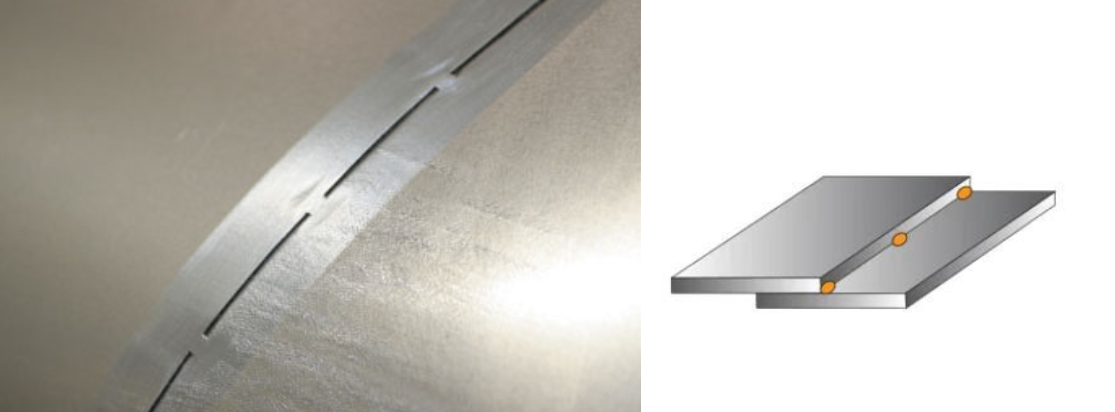
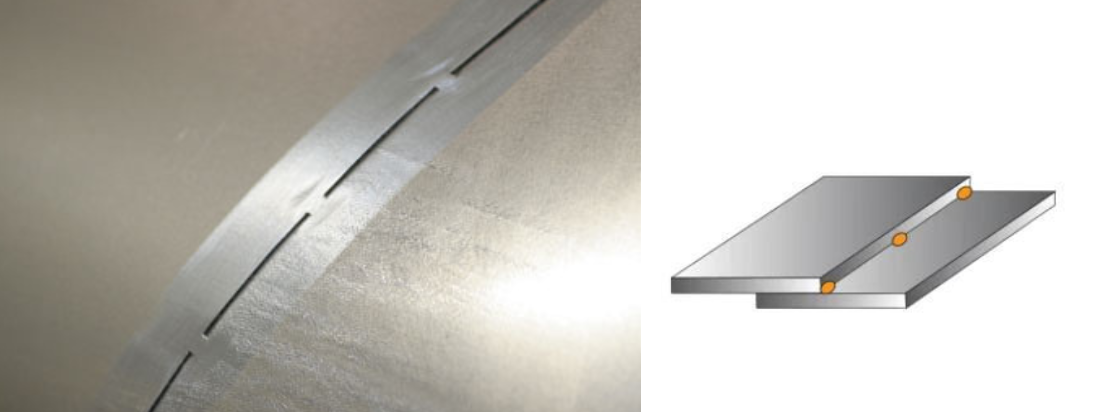
Exploring Spot Welding Techniques
Spot welding is an essential method in the world of metal fabrication. Used to temporarily stabilize metal parts before a final weld, this process plays a crucial role in the precise alignment of components. In 2020, the welding industry represented a $20 billion market, underlining the importance of efficient techniques such as spot welding. This article aims to explore this method in depth, detailing its principles, processes, applications, and suitable materials.
Definition and Principles of Spot Welding
Spot welding is distinguished by its ability to temporarily hold metal parts together. Unlike final welds, this technique uses moderate heat and a short welding arc to ensure initial fixation. The goal is to prevent any movement of the parts during the welding process, thereby guaranteeing perfect alignment. This preliminary step is essential for various applications, ranging from automotive construction to heavy equipment manufacturing.
Operational Process of Spot Welding
Spot welding relies on the use of an arc to join metal parts. Before starting, careful preparation is required. This includes cleaning the metal surfaces to remove oxides and other impurities that could compromise weld quality. Adjusting welding parameters, such as current and voltage, is also crucial. These settings must be adapted to the thickness and type of material being welded. Once these steps are completed, the arc creates a rapid fusion of metals, followed by cooling that ensures the strength of the joint.
Applications and Materials for Spot Welding
Materials Suitable for Spot Welding
The choice of materials for spot welding is determined by several factors, including thermal conductivity and susceptibility to distortion. Carbon steel is often preferred for its strength and ability to withstand high stresses. Aluminum, though lighter, offers excellent thermal conductivity, which facilitates heat dissipation. Copper, meanwhile, is used for its corrosion resistance and electrical conductivity. Each material has specific advantages that influence the effectiveness of spot welding.
Types and Forms of Spot Welds
Spot welds come in several types, each meeting specific needs. Standard welding is used to firmly hold heavy materials, while bridge welding fills gaps between metal parts. Thermite welding, on the other hand, uses a chemical reaction to generate high temperatures, making it possible to weld large parts. In terms of forms, the square point is ideal for right-angle assemblies, while vertical welding applies along the entire height of the pieces to be joined. These variations allow spot welding to be adapted to the structural requirements of projects.
Advantages and Limitations of Spot Welding
Spot welding offers several advantages, particularly its ability to temporarily secure parts, thus facilitating the final welding process. Its simplicity of use and low cost make it an attractive option for many industrial applications. However, this technique also has limitations. Temporary fixation cannot replace the strength of a final weld. Moreover, poor execution can result in distortions or misalignment of the parts. The success of spot welding therefore depends on the skill and experience of the welder.
Conclusion
By mastering spot welding, industry professionals can optimize their manufacturing processes and ensure high-quality results. This technique, although temporary, plays a crucial role in aligning and stabilizing metal parts, setting the stage for a successful final weld. As industries continue to grow and evolve, spot welding remains an essential skill for engineers and manufacturers worldwide.

Spot welding is a welding technique used to temporarily hold metal parts together before a final weld. It is essential for ensuring precise alignment of components during the welding process, which is crucial in industries such as automotive manufacturing and heavy equipment production.
Common materials used for spot welding include carbon steel, aluminum, and copper. Carbon steel is valued for its strength, aluminum for its thermal conductivity, and copper for its corrosion resistance and electrical conductivity.
Spot welding offers advantages such as ease of use, low cost, and the ability to temporarily secure parts. However, its limitations include the fact that it cannot replace the strength of a final weld, and poor execution may lead to misalignment defects.