Français



_11zon.webp)


_14_11zon.webp)
_6_11zon.webp)



Metal drilling: understanding the tools, methods and best practices
Metal drilling is an essential operation in many trades related to welding, boiler making, maintenance, metal construction, pipework and industrial assembly. It makes it possible to create precise holes for fastening, bolting, preparing a part, installing equipment or carrying out rework on an existing structure.
This blog category aims to help you better understand metal drilling methods, the tools used, the parameters to take into account and the best practices to adopt in order to work with precision, efficiency and safety. The goal is not only to choose a drill or drill bit, but also to understand how to properly prepare a drilling operation according to the material, thickness and working environment.
Why does metal drilling require proper preparation?
Unlike some softer materials, metal requires rigorous preparation. The type of steel, workpiece thickness, hole diameter, machine stability, rotation speed, feed rate and lubrication directly influence drilling quality. Incorrect settings can cause excessive heating, premature tool wear, an inaccurate hole or drill bit breakage.
Before drilling, it is therefore important to clearly identify the need: hole location, desired diameter, type of metal, accessibility of the area, workpiece clamping and expected level of precision. Good preparation helps reduce rework, improve consumable service life and achieve a cleaner result.
Magnetic drill, portable drill or workshop machine: choosing according to the application
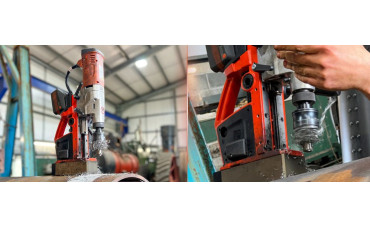
The choice of equipment mainly depends on the application. A portable drill may be suitable for simple or occasional operations. A workshop machine can provide greater stability and repeatability for parts that can be moved. A magnetic drill, on the other hand, is particularly useful for working directly on metal structures, beams, frameworks, rails or parts that are difficult to move.
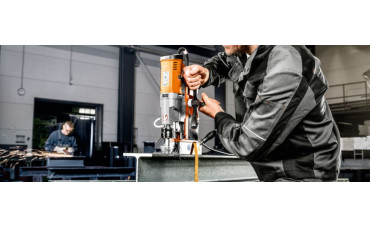
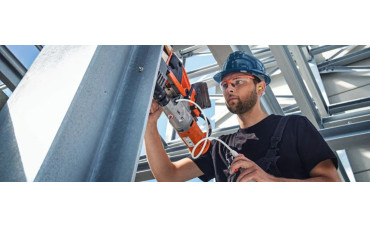
Thanks to its magnetic base, a magnetic drill can stabilise the machine on a ferrous metal surface and produce more precise drilling on site. It is often used in metal construction, industrial maintenance, worksite interventions or tasks requiring good mobility.
Drill bits, cutters and lubrication: key elements for successful drilling
Drilling quality depends as much on the machine as on the cutting tool used. Drill bits, annular cutters, carbide cutters, guiding accessories and consumables must be suited to the material being worked, the required diameter and the drilling depth. An unsuitable tool can generate vibrations, slow down the operation or damage the workpiece.
Lubrication also plays an important role. It helps reduce heat build-up, facilitates chip evacuation and improves the service life of cutting tools. Depending on the working conditions, it can be carried out with cutting oil, a suitable lubricant or a lubrication system integrated into the machine.
Core drilling, tapping, boring and chamfering
Metal drilling is not always limited to making a simple hole. Depending on the application, it may be necessary to core drill, tap, bore or chamfer a part. These operations make it possible to prepare a bolted assembly, create a thread, improve the fit of a part or achieve a cleaner finish before installation.
Each operation requires a suitable tool, consistent settings and good stability of the workpiece or machine. For professional work, positioning accuracy and control of cutting forces are essential to obtain a regular and usable result.
Safety when drilling metal
Metal drilling can present several risks: flying chips, cuts, burns, entrapment, tool blockage, noise, vibrations or movement of the workpiece. Before any operation, it is essential to check the condition of the machine, proper tool tightening, workpiece stability and the absence of elements that could be caught by rotation.
Personal protective equipment must be adapted to the operation: eye protection, fitted clothing, hearing protection if necessary, and gloves only when the situation allows it without any risk of entanglement in a rotating part. Chips must be removed when the machine is stopped, using a suitable tool, in order to avoid cuts and accidents.
Precision, stability and workstation organisation
Accurate drilling starts with a well-organised workstation. The workpiece must be properly secured, the drilling area must be clear and the markings must be visible. On worksites, the working position, access to the area, quality of the metal surface and stability of the equipment must also be taken into account.
For magnetic drills, adhesion quality depends on the surface, metal thickness and cleanliness of the contact area. A dirty, painted, uneven or too thin surface can reduce holding force. Checking adhesion and using the available safety devices help limit risks during the operation.
Our advice to better understand metal drilling
Through this category, HD Soudage helps you understand the different methods of metal drilling. You will find advice on magnetic drills, drill bits, cutters, core drilling, tapping, difficult surfaces, magnetic systems, portable circular saws and methods for preparing metal parts.
Whether you are a metalworker, boiler maker, welder, maintenance technician, workshop manager or professional working on site, this section will help you better understand drilling tools, selection criteria and best practices for producing clean, precise and safe holes.