
 Français



_11zon.webp)


_14_11zon.webp)
_6_11zon.webp)



How to Choose Your Equipment for Industrial Cutting
- LAURENT DAROLT
- 23 Jun, 2026
- Oxy-fuel cutting
.jpg)
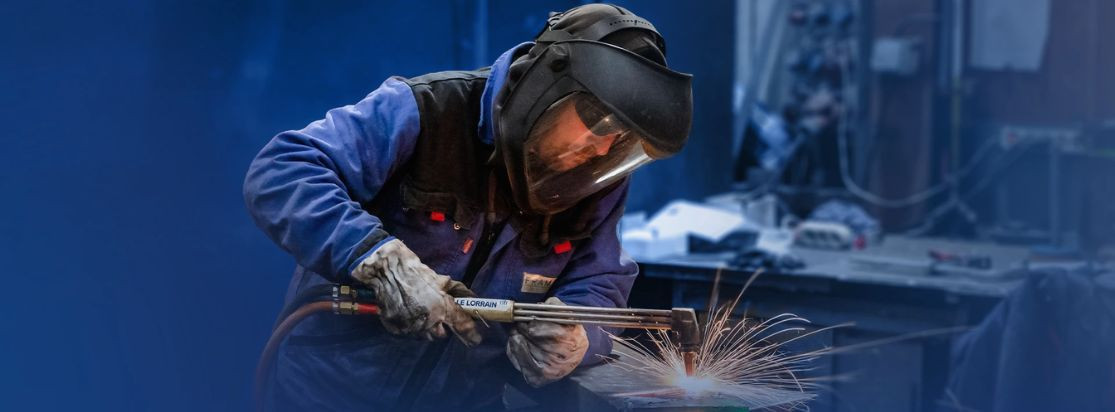
Mastering the art of thermal cutting
In the heavy metalworking and industrial maintenance sector, performance is not measured only by execution speed, but also by the Total Cost of Ownership (TCO) of the equipment. The choice between a plasma cutter and a cutting torch is often seen as a technical dilemma, when in reality it is a strategic decision. Poorly calibrated oxy-fuel cutting equipment leads to excessive gas consumption, premature nozzle wear, and hours of labour lost in deburring and post-cutting grinding.
In the age of Industry 4.0, oxy-fuel cutting remains a highly reliable solution for processing thick materials with complete autonomy. Choosing technical excellence means turning a simple cutting operation into an immediate profitability driver on your most demanding worksites.
Key Takeaways
- Superior cutting capacity: The only economically viable process for ferrous metal thicknesses exceeding 50 mm.
- Autonomy and safety: Essential in isolated or wet environments, such as shipyards and demolition sites, thanks to the absence of electrical components.
- Enhanced versatility: Unique ability to switch from cutting to heating or brazing with a single investment.
- Optimized maintenance: Choose removable mixers, such as DV1 MP1 type models, to reduce replacement costs for wear parts.
- Reliability guarantee: Le Lorrain stands out with 100% individual factory testing, ensuring absolute safety from the very first use.
Understanding the principle of oxy-fuel cutting to make better use of it
The quality of an industrial cut does not depend solely on the operator’s skill, but on mastering a precise chemical reaction: the exothermic oxidation of iron.
The gas mixture: the source of power
Oxy-fuel cutting uses a preheating flame, created by an oxygen/acetylene or propane mixture, reaching 3,000°C to bring the metal to its ignition temperature. The jet of pure cutting oxygen then literally “burns” the steel. Correct adjustment is therefore critical:
- Neutral flame: Perfect balance for a clean cut.
- Oxidizing flame: Excess oxygen, creating a short and noisy inner cone, increasing the risk of slag.
- Carburizing flame: Excess fuel gas, lengthening the inner cone and slowing down thermal penetration.
Versatility and autonomy: the strengths of the process
Its main advantage lies in its logistical independence. On demolition sites or naval structures, the absence of electrical cables eliminates the risk of electrocution in wet environments and removes dependence on costly generators.
Expert analysis: I see too many companies overlooking post-cutting processing time. A perfectly stable gas mixture, ensured by a long-reach mixing tube, delivers a clean cut that reduces subsequent grinding time by 30%. This is where productivity gains are made.
Selection guide: Which cutting torch is right for your activity?
The torch is the direct interface between the operator and the material. Its design determines handling precision and operational safety.
Low-pressure vs high-pressure torches
The usage context determines the technology:
- Low pressure (DV1 MP1, DV-MP1 type): The DV1 MP1 is the benchmark for versatility. Its removable mixer is a strategic advantage: in the event of clogging, you only replace the mixer and not the torch body, drastically reducing maintenance costs. It is compatible with oxygen, propane and natural gas.
- High pressure (DH1, HP1, HP2 type): These models are the workhorses of demolition and steelmaking. The “long-reach” versions allow operators to work at a distance from the heat source during heavy structural work.
Specific applications: from shipbuilding to heavy industry
Each trade has its own field requirements. For the shipbuilding sector, the DV1 R model is specifically designed to withstand frequent flashbacks in the confined spaces of ship holds, while offering handle ergonomics suited to work on ship hulls. For automated production, COUPEX-type machine torches guarantee millimetre-level repeatability.
Operational adaptability is achieved in the field. The quick-change lance system, exclusive to Le Lorrain, allows an operator to switch from a cutting lance to a heating lance in just a few seconds without returning to the tool store. This smooth time saving directly increases the number of cuts per workstation.
The 3 key purchasing criteria for your investment
Type of materials and cutting thicknesses
Oxy-fuel cutting is the undisputed master of thick carbon steel. Where plasma becomes prohibitive in terms of electricity consumption and consumable wear above 50 mm, the cutting torch maintains a linear cost. Make sure the chosen model supports the nozzle range required for your maximum thicknesses.
Ergonomics and equipment durability
Operator fatigue is the enemy of precision. A well-balanced torch, made with high-quality materials resistant to abrasion and radiant heat, extends the tool’s service life while helping preserve technicians’ health.
“Reliability is the first safety factor in industrial environments.”
Unlike market standards that rely on sample testing, Le Lorrain tests 100% of its production under real conditions before shipment. This rigor eliminates the risk of failure straight out of the box, providing essential peace of mind when managing time-sensitive worksites.
Safety and maintenance: Ensuring the long-term reliability of your equipment
Safety is not optional; it is a component of performance. A leak or flashback represents both a human risk and an immediate production shutdown.
Essential safety devices
To secure your installation, three elements are non-negotiable:
- Flashback arrestors: To stop any accidental gas backflow.
- Suitable pressure regulators: Choose “armoured” regulators for the construction and demolition sectors to protect pressure gauges from impacts and frequent breakage on these worksites.
- ISOCOUPLE quick couplings: They guarantee perfect sealing and safe connection/disconnection, even under residual pressure.
Maintenance and technical support
High-performance equipment must be maintained by experts. Access to responsive after-sales service and genuine spare parts is important to avoid equipment downtime. Preventive visits and calibrations ensure that your working pressures remain optimal for consistent cutting quality.
Choosing a premium brand gives you access to dedicated technical assistance. On complex projects such as gas networks or major shipbuilding sites, this technical support becomes a key competitive advantage to ensure the compliance of your installations.
Take action with Le Lorrain excellence
Oxy-fuel cutting remains an advanced technology with proven economic relevance for heavy maintenance, recycling and shipbuilding. By investing in robust, tested and ergonomic equipment, you secure not only your operators, but also your operating margins by reducing maintenance and post-cutting processing costs.
Changing industrial constraints call for tools with no compromise on precision and durability.
Ready to transform your productivity? Browse the full catalogue now or contact our experts to configure your high-performance oxy-fuel cutting setup and benefit from specialised Le Lorrain technical support.
Let’s talk about your project
An industry expert will respond within 24 business hours.
Industrial oxy-fuel cutting is a thermal cutting process used mainly on carbon steels. It is based on a preheating flame that brings the metal to its ignition temperature, followed by a jet of pure oxygen that oxidizes the metal to perform the cut.
Oxy-fuel cutting generally uses oxygen combined with a fuel gas such as acetylene, propane or natural gas. The choice of gas depends on the type of worksite, the required power, operating cost and the operator’s usual practices.
An oxy-fuel cutting torch is particularly suitable for carbon steels, especially for thick sections. It is less suitable for materials that do not oxidize favourably, such as stainless steel or aluminium, for which other cutting processes may be more appropriate.
A low-pressure torch is often valued for its versatility and ease of maintenance. A high-pressure torch is more suited to heavy-duty work, demolition, steelmaking or applications requiring high cutting capacity.
A quick-change lance system makes it easier to switch from a cutting operation to a heating operation. This improves productivity on site by reducing downtime and limiting returns to the tool store.
Flashback arrestors help limit the risk of gas or flame travelling back into the installation. They are among the essential safety devices when using a cutting torch.
Armoured pressure regulators are recommended for demanding environments such as construction, demolition or industrial worksites. They provide better protection for pressure gauges against impacts, falls and harsh working conditions.
A cutting nozzle should be replaced when it is clogged, deformed, worn or when it no longer produces a regular jet. A defective nozzle can cause an irregular cut, excessive gas consumption and increased slag formation.