
 Français



_11zon.webp)


_14_11zon.webp)
_6_11zon.webp)



Welding Duty Cycle: A Comprehensive Guide
- Nada Iddouch
- 24 Sep, 2025
- Welding machine
.jpg)
A welding professional knows how much the reliability of a welding machine influences the quality and continuity of work. On a construction site or in a workshop, the sudden shutdown of the equipment due to overheating can disrupt an entire production sequence. Knowing and correctly interpreting the duty cycle then becomes crucial to avoid costly interruptions and ensure optimal use of each machine.
The Duty Cycle: An Essential Feature for Welders
How the Duty Cycle Influences Welding Machine Performance
The duty cycle, more commonly referred to as "duty cycle" in technical documentation, plays a central role in assessing the performance of a welding machine. This measure indicates how long the machine can deliver a certain current without the risk of excessive heating within a standardized time period.
Specifically, this parameter is expressed on a fixed time basis: 10 minutes. This means that any figure given for the duty cycle always corresponds to a total interval of ten minutes, which is significant enough to cover the usual usage cycles in industrial or artisanal welding.
For example, if a machine shows a capacity of 255 amps at 40%, this does not imply unlimited operation. The information specifies that over ten minutes, the user can run the machine for four consecutive minutes at 255 amps before it must automatically stop to prevent any harmful overheating of its internal components. The remaining six minutes are then dedicated to cooling.
Overall performance therefore closely depends on the duty cycle stated by the manufacturer. A machine with a high duty cycle value will offer greater flexibility and reduce pauses imposed by internal thermal protection. Conversely, neglecting this data exposes the operator to unexpected shutdowns, which can affect both productivity and work quality.
Beyond just a number, the entire operational planning is impacted: scheduling long sessions or intensive work requires a careful reading of the duty cycle to ensure that each task can be completed without unplanned interruptions.
Interpreting Duty Cycle Values
The specifications generally use two distinct notations to make them easier to understand: one value corresponding to continuous operation (100%) and another associated with more intensive but time-limited use (less than 100%).
Let’s look at two typical examples found in product specifications:
- 151 A at 100%
This means that when set to 151 amps, the machine can run continuously for the full ten minutes — or even longer — without triggering any thermal safety shutoff. In other words, no pause is required between sessions as long as this intensity is not exceeded.
- 255 A at 40%
Here, the operating mode changes drastically: pushing the machine to 255 amps allows only four continuous minutes before the automatic anti-overheating system kicks in. The rest of the cycle then requires six minutes exclusively for cooling before resuming.
This dual display allows the welder or maintenance manager to precisely adapt the operating mode according to specific needs: either favoring moderate power with great consistency or a temporary higher peak necessarily accompanied by a longer break.
To quickly visualize these differences when selecting or setting up:
| Current (A) | Max duration (per 10 min) | Effective time | Mandatory pause |
|---|---|---|---|
| 151 | 100% | 10 min | - |
| 255 | 40% | 4 min | 6 min |
Clarity in interpretation prevents any unpleasant surprises during demanding work and, above all, allows for strict management of the thermal cycles imposed by the intrinsic characteristics of the equipment used.
Analyzing and Optimizing the Use of Your Welding Machine
Assessing Temperature and Performance Conditions
The environmental context has a significant influence on the thermal behavior of welding machines. Manufacturers generally establish their standard measurements considering a maximum ambient temperature set around 40 °C — a threshold often reached in some workshops during summer or in poorly ventilated shelters.
The closer the outside temperature rises to this limit, the faster residual heat accumulates during intensive welding. This phenomenon mechanically reduces the usable time before automatic shutdown due to thermal protection. In other words, even if the datasheet specifies “185A at 40%,” working in particularly hot conditions may require even more pauses to avoid internal damage or sudden shutdowns.
In the face of climate variations or confined environments where heat dissipation becomes difficult, adjusting settings is therefore an essential lever:
- Slightly reducing the selected intensity instantly extends the usable time between mandatory shutdown periods.
- Alternating active and inactive phases according to a tailored schedule allows internal components to properly release excess heat.
- Installing complementary solutions such as additional fans can sometimes also help temporarily push back the limits set by default on certain professional models.
Neglecting this aspect endangers not only your equipment but also your final results: excessive voltage under high heat = increased risks for your weld beads (localized deformations), premature wear, or even total breakdown within the first months if these recommendations are ignored.
Practical Examples and Real Applications
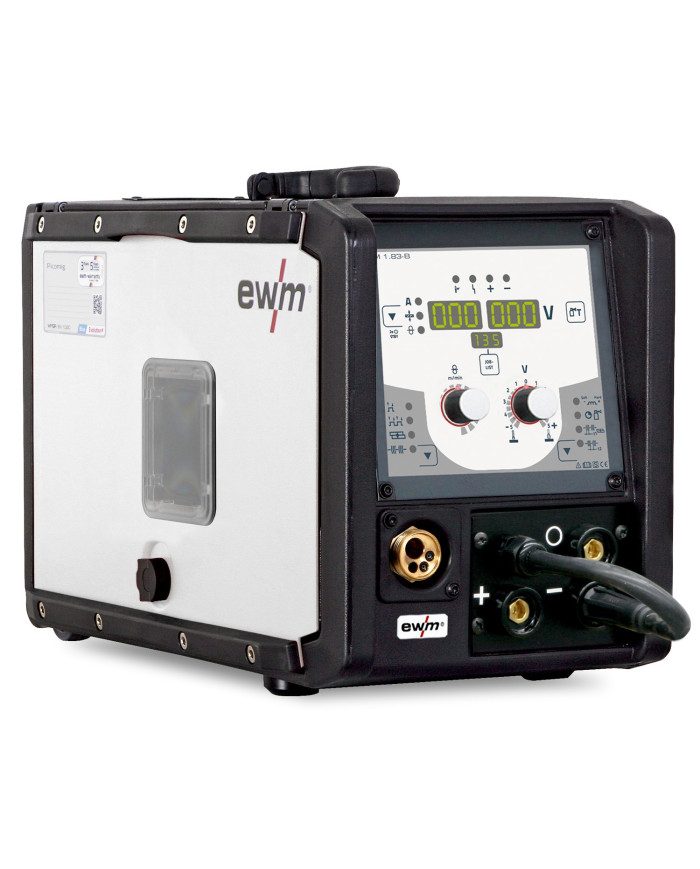
Portable welding machine Picomig 180 Synergic TKG
Theoretical analysis gains relevance as soon as it is compared with real cases from industrial or artisanal settings. Let’s take as a reference the Picomig 180 Synergic TKG model, whose technical data specifies distinct duty cycles:
- 100% at 100 A
- 60% at 120 A
- 25% at 180 A
Portable welding machine Picomig 180 Synergic TKG
Theoretical analysis gains relevance as soon as it is compared with real cases from industrial or artisanal settings. Let’s take as a reference the Picomig 180 Synergic TKG model, whose technical data specifies distinct duty cycles:
- 100% at 100 A
- 60% at 120 A
- 25% at 180 A
Based on these values, here is how the welding machine behaves in practice:
- When set to 100 amps, the machine can run continuously without interruption — ideal for repetitive joints or light welding tasks performed at a steady pace.
- At 120 A, the machine can handle a higher load for 6 out of 10 minutes, with a 4-minute cooling break if use exceeds this cycle; useful for more intense passes but moderate in duration.
- When pushed to 180 A, the machine reaches its maximum capacity, but only for very short intervals (25% of the time), about 2.5 minutes out of 10, before it must undergo a cooling period. This is relevant for short bursts on thicker materials.
This precise management of duty cycles allows you to adapt usage according to the context:
- Extended use with low current → favor settings around 100 A to avoid excessive heating.
- Intermediate, more demanding operations → take advantage of the 120 A level while respecting the cycle.
- Occasional power needs → use the 180 A setting for a burst of energy, but only over limited periods.
- Challenging ambient conditions → in cases of high temperature or restricted ventilation, compensate with longer rest phases even at intermediate settings.
By consistently relying on technical values such as these, rather than on impressions or habits, you not only optimize the lifespan of the machine but also ensure operational safety when facing thermal constraints and variable demands of the trade.
Fully understanding and mastering the duty cycle radically changes the way you approach your welding work. It allows you to:
- Effectively compare different competing models,
- Adjust your settings according to workshop conditions (schedule, temperature, ventilation),
- Anticipate downtime intelligently rather than endure it unexpectedly.
These best practices guarantee reliability, safety, and productivity on every project, whether in an industrial or artisanal context.
Not sure which welding machine is best suited to your environment? Our technical team is at your disposal to guide you and provide personalized support to help you make the most of your equipment’s potential.
Let’s talk about your project
An industry expert will respond within 24 business hours.
The duty cycle is a measurement that indicates how long a welding machine can operate at a certain current without overheating, within a standardized 10-minute period.
It determines how long the machine can be used without interruption. A high duty cycle allows more continuous use, reducing the cooling breaks required.
It means the welding machine can operate at 255 amps for 4 minutes within a 10-minute cycle, followed by a mandatory 6-minute cooling period.
Ambient temperature affects the thermal behavior of the welding machine. Higher temperatures can reduce operating time before the unit overheats.
By adjusting the welding current, alternating active and inactive phases, and using additional fans to improve cooling.
At 100%, the machine can run continuously without cooling breaks. At 40%, it requires regular pauses to prevent overheating.
By evaluating the duty cycle according to the intensity and duration of your tasks, as well as the environmental working conditions.