
 Français



_11zon.webp)


_14_11zon.webp)
_6_11zon.webp)



Save space with retractable welding screens
- Nada Iddouch
- 20 Feb, 2026
- Welding safety
.jpg)
Retractable Welding Screens: Optimizing Space Without Compromising Safety and Productivity
Between safety constraints and productivity demands, the welding industry requires solutions that are both reliable and practical. In workshops where space is valuable, bulky equipment slows down operations. Retractable welding screens have emerged as an effective solution, optimizing organization and simplifying daily setup.
The Impact of Retractable Screens on Floor Space
Welding workshops are often crowded with large pieces of equipment. Fixed screens used to protect operators take up significant space and easily create permanent clutter. Handling them can be complex: a dedicated area must be cleared, panels need to be moved, and the space must be reconfigured whenever a workstation or operation changes.
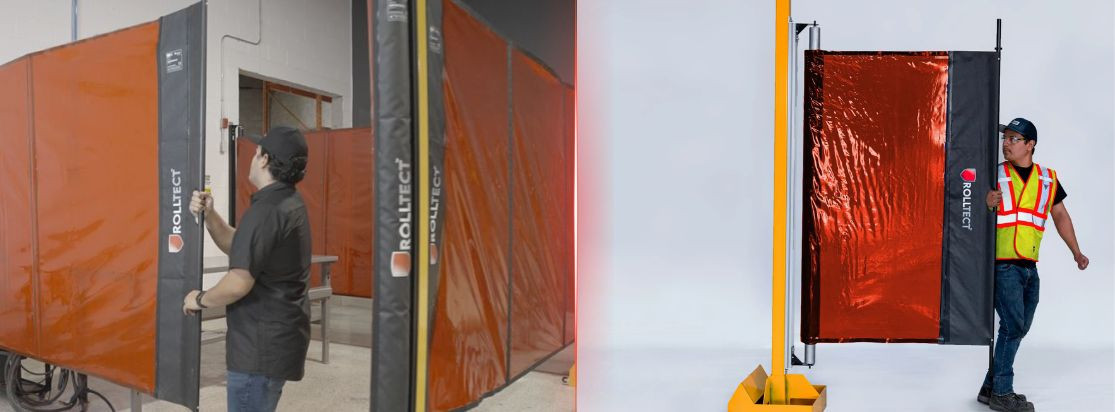
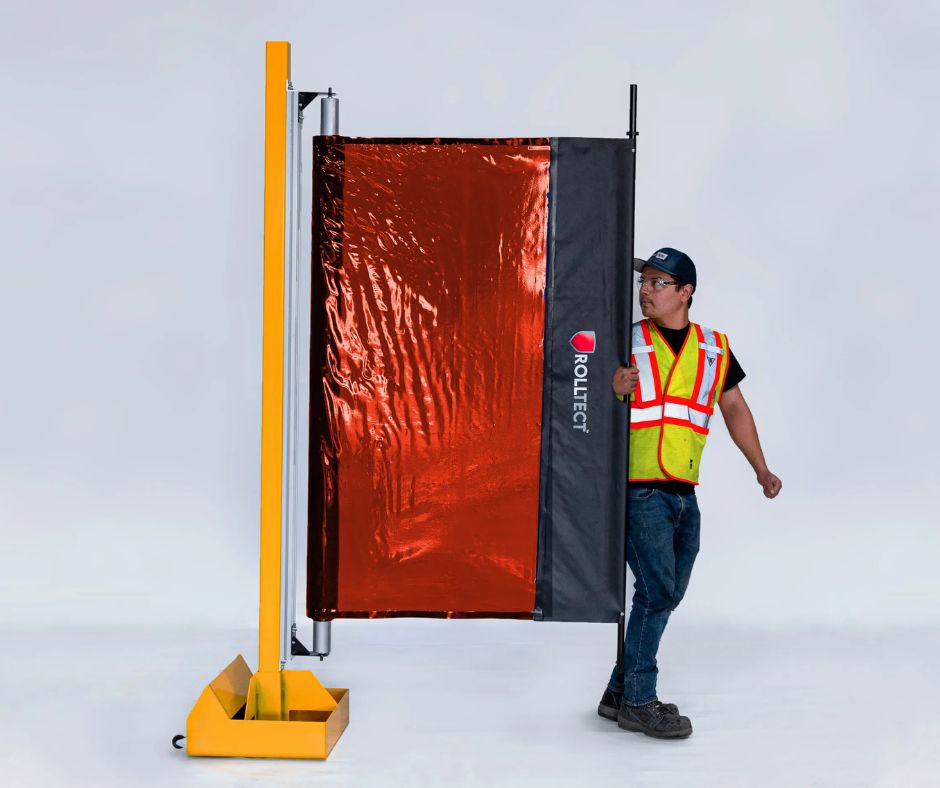
Retractable screens represent a turning point in spatial management. Their design allows for quick retraction when not in use, freeing up to 98% of the floor space compared to a traditional equivalent screen (for example, a 10x20-foot model). This feature immediately translates into more usable space for other tasks or mobile equipment.
In setups where multiple operations coexist—assembly, finishing, quality control—this ability to instantly clear floor space simplifies transitions between workstations. There is no longer a need to navigate around bulky barriers or painstakingly dismantle each panel to access a specific area. Switching from one activity to another becomes smooth and efficient.
This compact storage method also helps improve overall workshop organization. Fewer obstacles reduce the risk of trips or accidents related to moving heavy equipment. Circulation becomes easier for all personnel.
Reduced Installation and Dismantling Time
Installing or removing a traditional barrier generally involves several time-consuming steps: transporting each panel from storage, assembling their sometimes fragile structure, adjusting their positioning to fully cover the required area… This process can quickly slow down the setup or removal of temporary workstations.
The introduction of retractable models transforms this workflow: their high-performance spring system (certified for up to 500,000 cycles) significantly simplifies daily handling. A single back-and-forth motion is enough to deploy up to twenty linear feet, whereas three conventional panels would have been required—each demanding multiple manual operations and additional trips.
Comparative tests have shown a reduction in total assembly and dismantling time of up to 40%. This gain is significant in a workday marked by frequent changes: fewer interruptions mean greater production continuity and fewer “lost hours” spent on non-productive handling.
The durability of the mechanism also reduces the need for rushed replacements caused by premature wear, often seen with fragile traditional frames that bend under repeated impacts or deteriorate during internal transport.
| Operation | Traditional Screen | Retractable Screen |
|---|---|---|
| Trips back and forth (20 feet) | Minimum 2 to 3 movements | Only 1 movement |
| Installation Time | Long (manual setup and adjustments) | Short (quick and immediate deployment) |
| Occupied Floor Space | Large area permanently occupied | Minimal footprint, freed after retraction |
This new level of efficiency directly optimizes overall productivity: less waiting time before and after each task, and better allocation of skilled personnel to key missions rather than time-consuming logistics.
Enhanced Safety with Retractable Welding Screens
Improved Protection Against Welding Hazards
Working around welding operations involves regular exposure to hot sparks, flying metal debris, and harmful radiation—particularly ultraviolet (UV) rays. Even a minor failure in protective measures can result in severe burns or irreversible eye injuries for the operator or any nearby unprotected individual.
Retractable screens are specifically designed to provide an effective barrier against these multiple risks. Made from flame-retardant semi-transparent PVC (14 mil thickness), they offer natural fire resistance while efficiently filtering UV radiation and excessive heat generated during TIG, MIG, or manual arc welding operations.
Unlike standard solutions that do not always provide this essential dual certification, these models consistently meet current North American regulatory requirements—offering tangible assurance for companies committed to maintaining collective on-site safety.
Adjustable sizing also plays a critical safety role: too often, undersized protective barriers are still used, covering only part of the active workstation and allowing heat or sparks to escape beyond the intended area. Thanks to their extendable and retractable design, coverage can be precisely adjusted to match each real configuration—eliminating dangerous gaps without requiring multiple time-consuming installations.
Flexibility and Adaptability of Retractable Screens
Over time, very few workshops maintain the exact same layout: new parts to process, temporary modifications related to product size or unit output, simultaneous operations at different locations… In the face of constant change, only solutions capable of quickly adapting to the environment can secure a lasting place in modern industrial processes.
Retractable systems fully leverage their mobility: they can be easily repositioned in any direction as needed, without disassembly or significant effort—unlike rigid frames that are often poorly suited to evolving spaces.
Extension and retraction are performed using an integrated ergonomic rod, allowing precise adjustment even when obstacles surround the workstation.
This flexibility ensures effective protection during critical phases while freeing up space when no hazardous operations are underway.
To better meet the varying demands encountered daily:
- Modular configurations based on the desired width and depth
- Extension capability according to occasional needs
- Easier maintenance thanks to fewer fixed contact points
This adaptability overcomes the limitations of older systems, which are often too rigid. It enables fast, customized protection perfectly suited to the specific constraints of each workspace.
A flexible workshop thus gains both safety and efficiency by reducing unnecessary handling between operations.
Recommended Action
Adopting a retractable welding screen transforms the industrial environment: optimized available space, reduced handling time, enhanced safety through certified durable materials, and strong adaptability to daily operational constraints.
For technical information tailored to your workshop or to request a personalized assessment to modernize your installations, contact us.
Let’s talk about your project
An industry expert will respond within 24 business hours.
A retractable welding screen is a protective barrier that can be quickly deployed or retracted to free up floor space in a welding workshop. It is designed to be flexible and mobile, making it easier to reorganize the workspace.
Retractable screens offer several advantages, including significant space savings, faster installation and dismantling, and greater flexibility to adapt to frequent changes in workshop layout.
These screens provide enhanced protection against sparks, metal spatter, and UV radiation thanks to their flame-retardant PVC material. They comply with OSHA/ANSI safety standards, ensuring optimal protection.
Retractable screens can reduce total setup and dismantling time by up to 40% compared to traditional screens, improving production continuity and reducing interruptions.
Yes, they are designed to adapt to various welding processes, including TIG, MIG, and manual arc welding, thanks to their adjustable size and ability to provide full, secure coverage.
When retracted, these screens free up to 98% of the floor space they would otherwise occupy, allowing that area to be used for other tasks or mobile equipment.
Yes, retractable screens are designed for easy mobility thanks to their movable structure and integrated ergonomic rod, enabling precise adjustment even in the presence of temporary obstacles.