
 Français



_11zon.webp)


_14_11zon.webp)
_6_11zon.webp)



Fall Protection Equipment for Working at Height: Selection Guide
- LAURENT DAROLT
- 29 Oct, 2026
- Welding safety
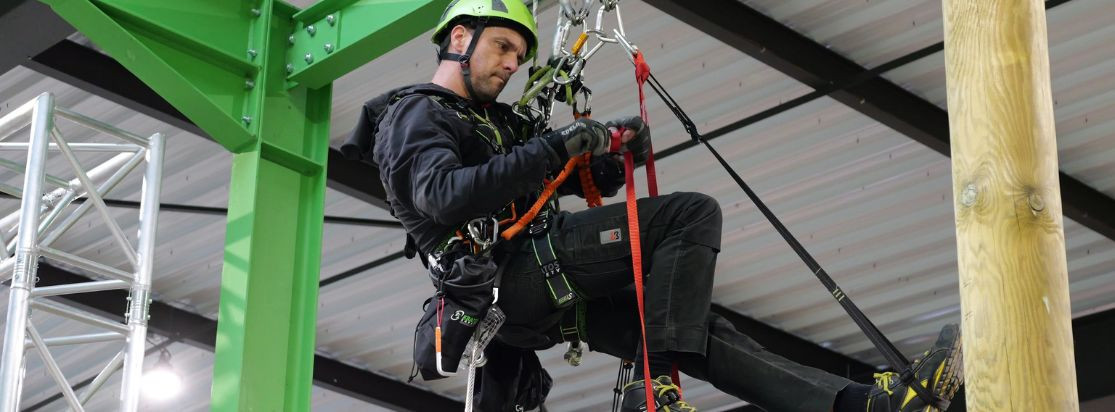
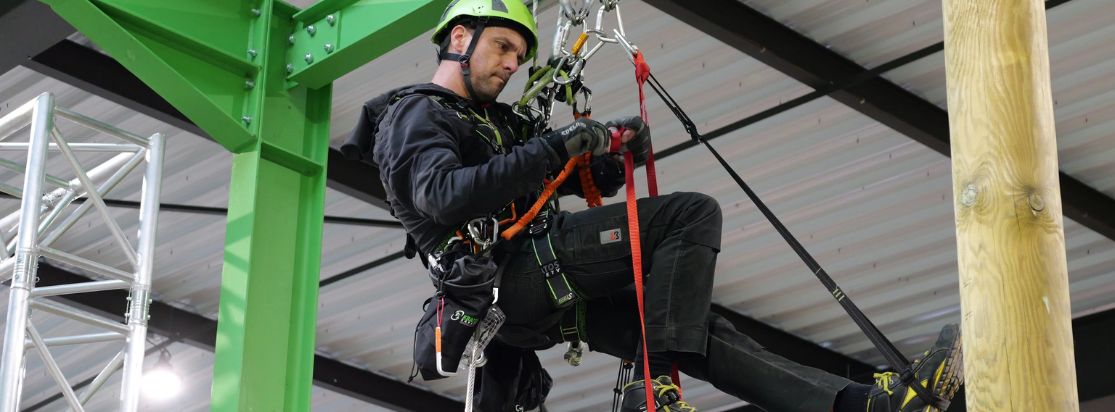
French regulations do not establish a general minimum height above which fall protection equipment is mandatory. The employer's risk assessment determines whether the work area needs to be secured. Collective protective measures must always take priority. Where collective protection is technically impossible, a personal fall arrest system must include an anchorage point, a safety harness, and a connecting component. Selecting the appropriate equipment requires distinguishing between restraint, work positioning, and fall arrest systems, as well as calculating the required fall clearance beneath the work area. The employer must also provide personnel with appropriate training, inspect the equipment, establish rescue procedures, and adapt protective equipment to specific hazards, such as those associated with welding.
Key Takeaways
- No legal minimum working height: The employer's risk assessment always takes precedence over the height at which work is performed.
- Collective protection takes priority: Guardrails and mobile elevating work platforms (MEWPs) must take precedence over personal protective equipment.
- Three essential components of a fall arrest system: A personal fall arrest system consists of an anchorage point, a safety harness, and a connecting component.
- Inspection and training requirements: Equipment must undergo an annual inspection, and working alone is strictly prohibited.
- Mandatory technical checks: Fall clearance calculations and component compatibility must be verified before starting work.
When Is Fall Protection Equipment Required?
Assessing Risks and Prioritizing Collective Protection
The employer's risk assessment determines the need for fall protection, with collective protective equipment always taking priority. This approach is based on the general principles of prevention established by the French Labour Code. Article R.4323-58 requires work platforms to be equipped to ensure safety and ergonomic working conditions. Employers must first seek to eliminate the risk by performing work from ground level. If this is not possible, collective protective measures, such as guardrails or temporary working platforms, must be installed. Personal protective equipment (PPE) must only be used as a last resort. Article R.4323-63 prohibits the use of ladders, stepladders, and step stools as workstations. Exceptions are permitted in specific circumstances, particularly when technical constraints prevent the use of alternative equipment or when the work is of short duration and presents a low risk. Regulations also require work to be suspended in adverse weather conditions. Understanding the different functions of fall protection PPE is essential for selecting the appropriate equipment.
Understanding the Differences Between Work Restraint, Work Positioning, and Fall Arrest
Fall protection PPE is divided into three distinct categories depending on whether it prevents access to a fall hazard, supports the operator in a working position, or arrests an actual fall. Selecting the wrong system can expose the operator to serious accidents. A work restraint system restricts the operator's movement to prevent them from reaching a hazardous edge or fall zone. A work positioning system supports the operator, allowing them to work hands-free. This system does not arrest a fall and may therefore require an additional fall arrest system. A fall arrest system stops a fall in progress, absorbs the impact energy, and keeps the operator suspended.
| System | Purpose | Typical Application | Operational Limitation |
|---|---|---|---|
| Work Restraint | Prevent the worker from reaching a fall hazard | Moving across a work platform near an unprotected edge | Cannot arrest a fall once it has started |
| Work Positioning | Support the worker in position while keeping both hands free | Working while supported or suspended on a structure | Requires an additional fall arrest system if a fall risk remains |
| Fall Arrest | Arrest a fall and absorb the impact energy | Working at height above an unprotected drop without collective fall protection | Requires sufficient fall clearance beneath the work area |
Identifying the function of each system makes it possible to select the appropriate equipment configuration.
How to Assemble a Complete Fall Arrest System
Choosing the Right Safety Harness and Attachment Points
Selecting the appropriate harness depends on the user's body shape, frequency of use, and the attachment points required for the task. A full-body safety harness (NF EN 361 standard) is the only body-holding device permitted for fall arrest. A harness used on its own does not provide protection against falls. It must be connected to a reliable anchorage point through a suitable connecting component. Sternal and dorsal attachment points (NF EN 361) are designed for fall arrest systems, helping distribute impact forces across the body. Lateral attachment points (NF EN 358 standard) are used for work positioning when the operator is supported against a structure. The ventral attachment point allows suspension and rope access operations. The XIMO 2 safety harness with work positioning belt illustrates this configuration by combining fall arrest attachment points with lateral work positioning points. Selecting the appropriate connecting component and anchorage completes the system.
Choosing the Connecting Component and Anchorage Point
The choice of connecting component depends on the available fall clearance beneath the operator and the configuration of the anchorage point. The connecting component attaches the harness to the anchorage (NF EN 795 standard), forming a complete fall arrest system (NF EN 363 standard). There are three main types of connecting systems:
- Energy-absorbing lanyard (NF EN 354, NF EN 355 and NF EN 362 standards): Its maximum length is 2 metres. It requires sufficient fall clearance, calculated in relation to the anchorage point.
- Self-retracting fall arrester (NF EN 360 standard): This device incorporates a webbing strap or cable wound onto a reel with an automatic locking mechanism. The Olympe-S2 self-retracting fall arrester is designed to limit the free-fall distance.
- Guided-type fall arrester on a flexible or rigid anchor line (NF EN 353-1/2 standards): This automatic device follows the operator during vertical movement along a rope, cable or rail.
Before using this work-at-height safety equipment, it is essential to understand the distinction between fall clearance and the available clearance beneath the work area. For energy-absorbing lanyards, fall clearance is calculated in relation to the anchorage point. For self-retracting fall arresters, manufacturers' instructions specify the required clearance beneath the working area, as anchorage positions may vary. This calculation takes into account the fall factor and a minimum safety margin of one metre. A fall over a sharp edge or a fall factor of 2 can significantly increase the required clearance. These situations require equipment specifically approved for sharp-edge hazards. A pendulum or swing fall can also cause lateral impact if the operator moves away from the vertical axis of the anchorage point. Kratos Safety fall protection solutions include equipment designed to meet these technical requirements. Specific working environment conditions must also be considered when selecting materials.
How to Use and Inspect Fall Protection Equipment
Adapting Equipment to Welding and Working Environments
Welding operations and specialised working environments require equipment that has been tested and approved for the thermal, chemical or atmospheric conditions encountered. Sparks and molten metal spatter can rapidly damage conventional synthetic webbing. The FIRE FREE range from Kratos Safety is designed to provide protection against thermal hazards and sparks. Other specialised ranges address specific risks, such as the FREE BLAST range for potentially explosive atmospheres (ATEX) or the DIELECTRI range for electrical hazards. These specialised products are not simply interchangeable alternatives. Nor do they provide completely fireproof protection or universal electrical insulation. Employers must strictly observe the operating limitations specified in the manufacturer's instructions. Operational safety management also requires rigorous equipment inspections and effective measures to protect personnel.
Inspecting Equipment, Arranging Periodic Checks and Planning Rescue Procedures
The three essential inspection requirements include a visual inspection before use, an annual periodic inspection, and the immediate withdrawal of equipment from service if there is any doubt about its condition or if it has arrested a fall. The employer is responsible for maintaining equipment compliance under the French Labour Code (Articles R.4323-61, R.4323-99 et seq.) and the Order of 19 March 1993. Before each operation, the user must visually inspect the stitching, webbing and connectors. A competent person must perform a periodic general inspection (VGP) at least every 12 months. The results must be recorded in the safety register. Any equipment that has arrested a fall must be removed from service. Employers are also required to provide employees with appropriate training in the use of fall protection PPE (Article R.4323-106). Article R.4323-61 prohibits working alone when using a personal fall arrest system without arrangements ensuring rapid rescue. This requirement helps ensure that immediate rescue can be organised to prevent suspension trauma (also known as harness suspension syndrome), which can become life-threatening within minutes. An overview of the main steps provides a summary of an effective fall prevention strategy.
Conclusion
The Essential Safety Principle
Effective fall protection relies on a thorough risk assessment, prioritising collective protective measures, and using a personal fall arrest system consisting of three fully compatible components. The overall approach begins with assessing workplace hazards and installing collective protection, such as guardrails, wherever possible. When personal fall protection is necessary, the employer must ensure that the anchorage, harness and connecting component are compatible. Employee training, regular equipment inspections and a rescue plan complete the safety arrangements.
Have Your Equipment Configuration Checked
Before any equipment is put into service, it is advisable to have the technical compatibility of each component and the fall clearance calculations verified by a specialist. Every worksite presents unique geometric constraints that require an individual assessment. To equip your teams with compliant, warranty-backed equipment, explore our complete selection of work-at-height safety equipment.
Sources and References
- French Labour Code: Articles R.4323-58 to R.4323-68 (Temporary work at height, collective protective measures and exemptions for ladder use under Article R.4323-63), Article R.4323-61 (Rescue arrangements and restrictions on lone working), Articles R.4323-99 to R.4323-106 (PPE inspections and training requirements).
- French Regulatory Texts: Order of 19 March 1993 (Periodic general inspections of personal protective equipment against falls from height).
- European Standards (EN): NF EN 361 (Full-body harnesses), NF EN 358 (Work positioning), NF EN 354 (Lanyards), NF EN 355 (Energy absorbers), NF EN 360 (Retractable-type fall arresters), NF EN 353-1/2 (Guided-type fall arresters), NF EN 362 (Connectors), NF EN 795 (Anchor devices), NF EN 363 (Personal fall protection systems).
- French National Research and Safety Institute (INRS): Publication ED 6110 (Prevention of Falls from Height); regulatory guidance on fall protection PPE and working at height.
- French Professional Organisation for the Prevention of Accidents in Construction and Public Works (OPPBTP): Prevention guides and practical information sheets (Working at Height: No Room for Error! / Wearing a Fall Arrest Harness).
- Kratos Safety: Equipment selection guides (Harnesses, belts and ready-to-use kits) and technical documentation for the i-beSafe tool (Fall clearance calculations, available clearance beneath the work area, fall factors and sharp-edge hazards).