
 Français



_11zon.webp)


_14_11zon.webp)
_6_11zon.webp)



Modern Stud Welding Techniques & Innovations
- Nada Iddouch
- 13 Jan, 2026
- Welding equipment rental
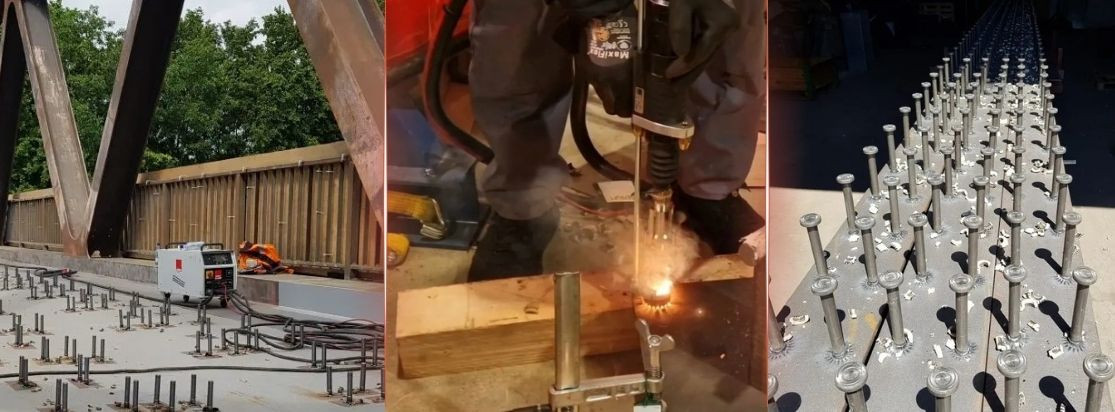
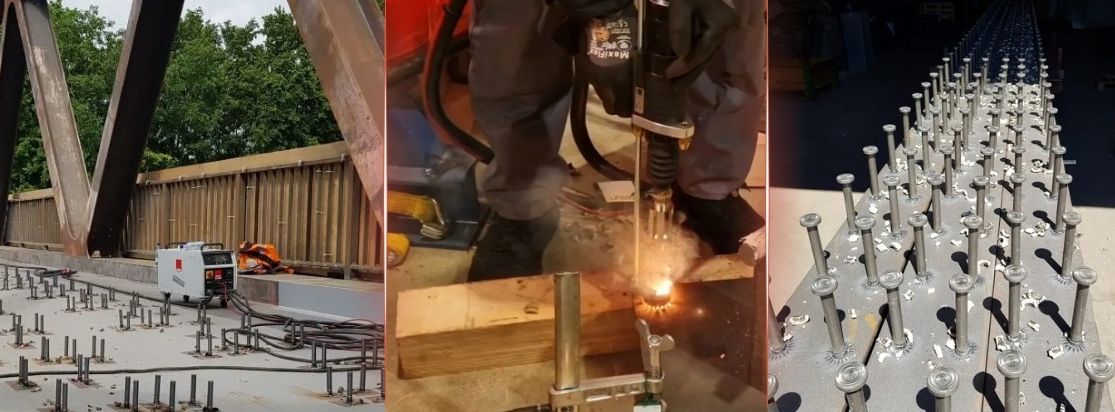
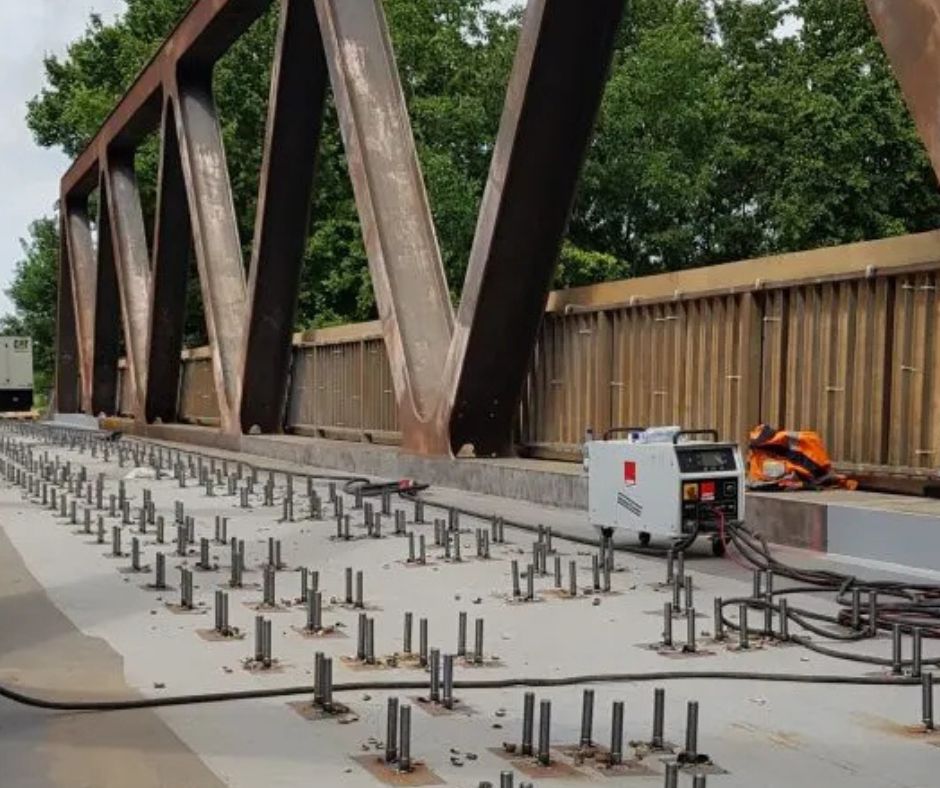
The assembly of metal structures relies on processes capable of combining strength, speed, and precision. Stud welding has established itself as an essential solution in this context. This method makes it possible to securely fasten a stud—a metal rod—to a surface without prior drilling or weakening of the base material. This clear gain in productivity meets the growing demands of industrial sectors where reliability and production speed are central concerns.
Understanding Stud Welding Techniques
Innovations in Arc Stud Welding
Arc stud welding has profoundly transformed metalworking. This process uses an electric arc that simultaneously melts the tip of the stud and the receiving surface, creating a strong bond in a very short time. Two main variants structure this family: long-cycle arc welding and short-cycle arc welding.
Long-cycle arc welding: for thick materials
When applications require particularly strong fastening on thick substrates, long-cycle arc welding is used. Mainly applied to steel or stainless steel, it is especially relevant in heavy fabrication or load-bearing elements in steel construction. The operation consists of striking an electric arc between the tip of the stud (from 6 to 25 mm or more) and the metal workpiece. The energy released melts a targeted area; a mechanism then quickly plunges the stud into this molten pool, creating a homogeneous weld without the addition of filler material.
Protection of the molten pool is ensured by a ceramic ferrule or sometimes by an inert gas shield, preventing any external contamination during the critical melting phase. For example, this method is commonly used to secure metal anchors for composite concrete–steel structures—bridges or industrial buildings—where each fastening point must guarantee maximum safety and long-term structural strength.
Short-cycle arc welding: precision on thin sheets
For fast assemblies on thin substrates (up to 1 mm), short-cycle arc welding is preferred. Here, the electrical impulse lasts only 20 to 30 milliseconds so that heat remains localized around the impact point, without causing deformation or altering the overall mechanical properties of the part.
Suitable for steels, aluminum, and sensitive alloys alike, this process is indispensable in automated production lines—for example, to attach clips or insulation to automotive body panels. It is also widely used in the assembly of household appliances, where every millimeter matters to preserve design and functional integrity.
The advantages are significant: perfect repeatability thanks to robotic systems capable of welding several studs per second; no rework required on the opposite side; and a drastic reduction in corrosion risks since no drilling is necessary. In a typical vehicle, between two hundred and four hundred fastening points are produced using this principle.
Capacitor Discharge Stud Welding
When fineness is the overriding criterion, capacitor discharge stud welding becomes the preferred solution.
This process is based on the ultra-fast discharge (1 to 3 ms) of a bank of capacitors through an ignition tip located at the top of the stud. This localized energy shock instantly generates the required fusion: no marking appears on the reverse side, even with the thinnest sheets used in decorative or light electronic applications.
Generally limited to diameters less than or equal to M8 (or up to M12 with certain advanced equipment), this technique ensures perfectly reproducible long production runs with reduced machine investment. It is less suitable for sectors requiring high mechanical strength, but it excels wherever visual aesthetics and total absence of deformation are paramount—high-end metal signage, decorative cladding, or miniaturized electronic enclosures.
Technological Advances and Applications of Stud Welding
Automation and Digitalization of Processes
Recent changes are not limited to the physical core of welding but also extend to its technical environment: improved ergonomics, advanced automation of operating cycles, and growing digitalization are radically transforming industrial practices.
Lightweight equipment & mobility
Modern generators have seen their weight drastically reduced thanks to inverter technology. Whereas an M12 unit previously weighed more than forty kilograms for the thirty-two amperes required at startup (often necessitating an electrician’s intervention), it is now possible to use an equivalent generator weighing less than twenty kilograms—making transport and installation easier, even on hard-to-access sites such as elevated work areas or confined locations.
The simultaneous reduction in overall size also allows these machines to be integrated directly into automated production lines without disrupting their original layout. Today, some compact models weigh less than sixteen kilograms without compromising power or technical reliability.
Intelligent automation & digital interfaces
Embedded intelligence now supports every critical stage: automatic feeding via vibratory bowls that consistently deliver each new stud to the application gun; numerically controlled tables that automatically position each welding point according to plans imported from specialized software; preset adjustments controlling applied force, speed, and current throughout the entire cycle. All of this contributes not only to reducing the need for highly trained personnel but also to minimizing human risk associated with repetitive manual operations.
Advanced software features are also emerging: programmable alerts triggered after a defined number of operations—preventing oversights during complex balancing procedures—and progressive integration with industrial MES/ERP systems, enabling full traceability down to the smallest machine parameter used for each production batch.
At the same time, the growing adoption of “smart screens” borrowed from other technological fields facilitates rapid familiarization, even for operators with little experience of such specialized equipment, further enhancing overall attractiveness for companies facing a chronic shortage of skilled labor.
Industrial Applications and Economic Benefits
The range of applications covers nearly all fields working with ferrous or non-ferrous metals:
- Automotive: rapid fastening of internal and external vehicle wiring, without destructive drilling.
- Civil engineering / composite construction: concrete–steel structural connections ensuring long-term mechanical performance.
- Shipbuilding / marine: assemblies subjected to strong vibrational stresses requiring homogeneous welds.
- Household appliances / electronics: invisible integration of support elements for internal components.
- Industrial decoration / signage: clean, aesthetically flawless fastenings, even on very thin visible surfaces.
The savings achieved stem as much from eliminating traditional operations (multiple drilling followed by tapping) as from removing the need for post-weld rework on the opposite side, often required when materials undergo excessive thermal stress. Production rates can therefore easily reach several hundred or even thousands of fastening points per day per machine. At the same time, tooling costs decrease, since the machines can be reused simply by changing the chuck or adapter according to the diameter and type of stud selected.
The growing diversity of available shapes and materials offers considerable flexibility in meeting specific customer requirements: miniature threaded versions and sophisticated movable hinges now coexist within the catalogs of leading suppliers in the field, ensuring precise adaptation regardless of the industrial project under consideration.
| Process | Preferred applications | Typical diameter | Base material thickness | Main advantage |
|---|---|---|---|---|
| Long-cycle arc | Heavy structures / Civil engineering | 6–25 mm | Thick (> 3 mm) | High mechanical strength |
| Short-cycle arc | Automotive / Light industry | Small diameters | Thin (from 1 mm) | Speed and no deformation |
| Capacitor discharge | Decoration / Electronics | ≤ 8–12 mm | Very thin (< 1 mm) | Extreme precision and flawless finish |
Recent developments, such as active shielding with inert gas (“Stud Inert Gas”) or the elimination of ceramic ferrules through patented magnetic processes (“Stud Welding in a Radially Symmetric Magnetic Field”), enable significant energy savings while opening access to new large-scale production markets.
In summary, choosing the appropriate process will always depend on a subtle combination of factors: the type of base material being worked (metal type, weight, thickness), the required level of structural performance, and the specific expectations related to the desired final design.
To fully benefit from the latest technological advances adaptable to your existing production lines—whether for large-scale robotic integration or flexible, one-off installations—contact our technical specialists now to receive a customized study tailored to your specific industrial sector.
We also offer stud welding machines for rental, providing a flexible and cost-effective solution for your occasional needs or testing phases.
.jpg)
Let’s talk about your project
An industry expert will respond within 24 business hours.
Stud welding is a process that makes it possible to fasten a metal stud to a surface without requiring prior drilling, ensuring a strong and fast joint.
Long-cycle arc stud welding is ideal for thick materials, providing high mechanical strength and being mainly used in heavy fabrication and load-bearing steel structures.
This process is suited to thin base materials, enabling fast assemblies without deformation, making it ideal for the automotive industry and household appliances.
Capacitor discharge stud welding uses a rapid discharge of capacitors to weld studs, making it ideal for very thin materials where precision and aesthetics are paramount.
Automation ensures perfect repeatability, reduces the need for highly trained personnel, and minimizes the risk of human error, thereby increasing efficiency and productivity.
Automotive, civil engineering, shipbuilding, household appliances, and industrial decoration are among the industries that benefit greatly from stud welding.
Innovations include inert gas shielding and the use of magnetic fields to eliminate ceramic ferrules, improving energy efficiency and opening up new markets.