
 Français



_11zon.webp)


_14_11zon.webp)
_6_11zon.webp)



Welding Galvanized Steel: Technical Guide to Safety, Quality, and Anticorrosion Repair
- LAURENT DAROLT
- 03 Sep, 2026
- Welding safety
Welding galvanized steel is a high-liability operation often misclassified as a routine industrial task. While achieving a high-quality, compliant joint is entirely feasible, success is strictly contingent upon a departure from "standard" steel protocols. Structural integrity and occupational safety depend on the precise identification of the coating, rigorous mechanical stripping, high-efficiency source capture of fumes, and the mandatory restoration of the sacrificial zinc layer. The central technical challenge is the pyrolytic decomposition of the coating; the formation of zinc oxide white fumes not only creates metallurgical defects but presents an immediate toxicological profile for the operator.
Treating galvanized steel as regular "black" steel is a failure of engineering oversight. Structurally, it leads to internal gas entrapment and embrittlement that compromises the mechanical properties of the joint. Legally and ethically, the uncontrolled release of zinc and alloying vapors violates European health directives (EU-OSHA) and specific technical rules such as TRGS 528.
Key Points to Remember
- Stripping Geometry: To ensure weld integrity and limit toxic emissions, the zinc coating must be mechanically removed at least 25–50mm from the joint edges.
- Vaporization Disparity: Zinc boils at ~907°C, while steel melts at ~1,500°C; this temperature gap causes violent gas expansion and high-pressure entrapment in the weld pool./li>
- A-Staub Classification: Per BAuA A121, welding fumes are treated entirely as A-Staub (alveolengängige Fraktion/respirable fraction), requiring the strictest filtration and monitoring.
- Metal Fume Fever Latency: Acute exposure to zinc oxide triggers flu-like "fièvre des métaux" with a typical latency period of 3–12 hours post-exposure.
- Restoration Compliance: Post-weld repair must strictly adhere to EN ISO 1461 to maintain the structural life cycle and prevent localized galvanic corrosion.
Understanding the chemical and physical transformations of zinc under the thermal stress of the arc is the prerequisite for implementing safe operational parameters.
Thermal Behavior and Metallurgical Impact of Zinc
The strategic difficulty in welding galvanized steel is dictated by the physical disparity between the base metal and its coating. The boiling point of zinc (approx. 907°C) is significantly lower than the melting point of the steel substrate.
Zinc Transformation Under the Arc
According to BAuA A121 and TRGS 528, the thermal energy of the arc causes the zinc coating to vaporize instantly. As these vapors reach the atmosphere, they oxidize into zinc oxide, manifesting as dense white fumes. This rapid transformation creates a high-pressure environment at the leading edge of the weld pool.
Impact on Weld Integrity and Quality
Residual zinc vapors interact with the molten pool, leading to several critical defects:
- Porosity: Vaporized zinc trapped beneath the solidifying steel creates spherical gas pores and wormholes.
- Increased Spatter: The violent expansion of zinc gas disrupts metal transfer, leading to excessive cleanup and poor aesthetic quality.
- Arc Instability: Zinc vapors interfere with the ionization of the shielding gas, causing an erratic arc and inconsistent penetration.
- Liquid Metal Embrittlement (LME): A severe structural risk where liquid zinc penetrates the grain boundaries of the base steel under stress, causing micro-cracking that can lead to catastrophic failure.
The "So What?" of Porosity: Under EN 1090-2, excessive porosity is a non-conforming defect. It reduces the effective cross-sectional area and fatigue resistance of the joint, leading to a legal inability to CE-mark a structural component without total rework.
Health Hazards: Zinc Oxide and the "Fume Factor"
Occupational health monitoring is a strategic necessity, as the IARC classifies all welding fumes as Group 1 (humankanzerogen). In the European workshop, the framework is set by the ArbMedVV and TRGS 900.
Metal Fume Fever and Acute Toxicity
Inhalation of zinc oxide particles causes Metal Fume Fever (fièvre des métaux). Based on INRS FT 75, symptoms include chills, fever, nausea, and a metallic taste. The danger lies in the 3–12 hour latency period; an operator may feel healthy during the shift only to become severely ill overnight.
Respiratory and Long-Term Risks: The Lead Components
Safety assessments must prioritize the "lead components" (Leitkomponenten) defined in the source data:
- Manganese (Mn): The lead risk for unalloyed steel. The limit is a stringent 20 µg/m³ in the A-fraction (respirable fraction) per TRGS 900.
- Nickel (Ni): In the welding of alloyed galvanized components, nickel oxide is a major concern. The acceptance concentration (Akzeptanzkonzentration) is 6 µg/m³ in the A-fraction (TRGS 910).
- Total Dust: While the general threshold is often cited as 3 mg/m³, safety engineers must remember that welding fume is classified entirely as A-Staub (respirable), penetrating deep into the alveoli.
Preparation and Local Coating Removal
Mechanical or chemical preparation is the non-negotiable first line of defense in both quality control and risk prevention.
Identification and Stripping Methods
Before ignition, the zinc layer must be removed via:
- Grinding: Using abrasive discs to strip the zinc until the bright base steel is exposed.
- Chemical Stripping: Controlled acid dissolution followed by neutralization, particularly effective for complex geometries where grinding is impossible.
Geometric Requirements for Stripping
To prevent "inclusion" defects, the zinc must be cleared 25-50mm from the joint. Insufficient stripping allows residual zinc to melt and flow into the root of the weld, creating defects that cannot be repaired without total removal and rework of the joint.
Process Selection and Operational Parameters
The choice of process is a strategic balance between productivity, fume emission, and joint quality.
Process Comparison
| Process | Suitability for Galvanized | Fume Emission Level | Risk of Porosity | Technical Note |
|---|---|---|---|---|
| MAG (Mischgas) | High (with prep) | High | Moderate | Requires high CO₂ for arc stability. |
| MMA (Stabelektrode) | Moderate | High | Low | Slag from the Umhüllung (coating) helps “scavenge” zinc. |
| TIG (WIG) | Low | Low | High | Highly sensitive to even trace zinc residues. |
| MIG Brazing | Very High | Moderate | Very Low | Uses CuSi/CuAl fillers melting at approximately 1000°C, preserving the coating. |
MIG Brazing Advantage: By utilizing copper-silicon (CuSi) or copper-aluminum (CuAl) filler metals, the process operates closer to the zinc boiling point, significantly reducing vaporization and preservation of the anticorrosive properties of the surrounding area.
Consumables and Shielding Gas
Flux-cored wires (fil fourré) are highly effective for galvanized steel. The "boil out" effect is achieved through a chemical reaction between the flux components and the zinc vapor, reducing entrapment. For MAG welding, increasing the CO2 content in the shielding gas assists in stabilizing the arc when minor residues persist.
The STOP Hierarchy: Mastery of Fume Exposure
European safety management follows the STOP principle (Substitution, Technical, Organizational, Personal) derived from TRGS 528.
Technical Measures: Capture at Source
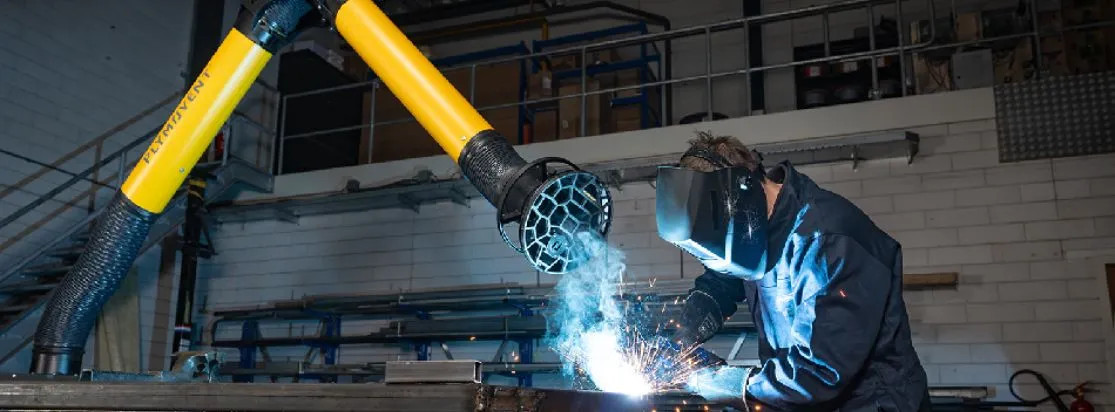
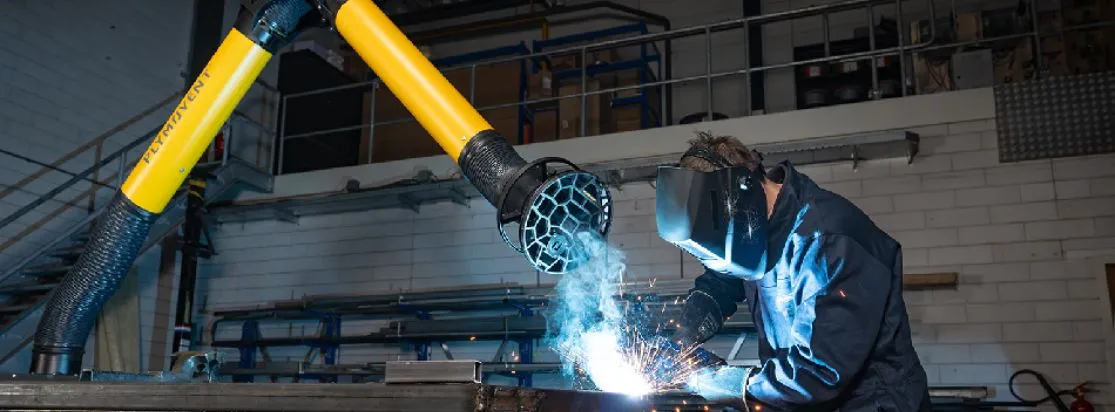
Per EN ISO 21904, the use of high-vacuum extraction torches or mobile suction arms is mandatory. Working outdoors is never a substitute for source capture; the operator’s breathing zone remains vulnerable to the concentrated plume.
Protective Equipment and Bystander Management
- PPE: P3 filters or supplied-air respirators are required if source capture cannot maintain levels below the 20 µg/m³ Mn limit.
- Bystander Safety: Managers must utilize the "Drehscheibe Lichtbogenschweißen" (BAU-A Welding Disc) to assess the risk radius for other workers in the vicinity and establish appropriate exclusion zones.
Post-Weld Anticorrosion Restoration
The restoration of the galvanized layer is critical for legal compliance with EN ISO 1461 and ISO 12944.
Surface Conditioning
The weld must be cleaned of all slag and the "white rust" (oxidized zinc) before re-protection. Any residual oxides will cause the restoration layer to fail.
Re-protection Methods
- Zinc-Rich Paints: Suitable for minor touch-ups.
- Thermal Spraying (Metallization): The professional standard for total restoration, involving the spraying of molten zinc.
- Zinc Alloy Sticks: Low-melting-point alloys applied to the pre-heated weld for a high-purity bonded layer.
Conclusion and Professional Recommendations
The Answer to Remember
Welding galvanized steel is a specialized skill requiring a four-step linear framework: Prepare (Strip) -> Capture (Extract) -> Weld (Process Selection) -> Restore (ISO 1461).
Recommended Action Plan for Managers
- Audit Ventilation Performance: Use EN ISO 10882 protocols to sample airborne particles at the operator's breathing zone and verify that extraction systems are functional.
- Validate the WPS: Ensure the Welding Procedure Specification explicitly accounts for the CuSi/CuAl consumables or flux-cored wires necessary for these coatings.
- Regulatory Review: Ensure the safety assessment (Gefährdungsbeurteilung) reflects the current TRGS 900 limit for Manganese (20 µg/m³).
Sources Cited
- BAuA A121: Spartenbezogene Handlungshilfe für Betriebsärztinnen und Betriebsärzte.
- TRGS 528 / TRGS 900 / TRGS 910: German Technical Rules for Hazardous Substances.
- EN ISO 1461: Hot dip galvanized coatings on iron and steel.
- EN ISO 10882: Health and safety in welding – Sampling of airborne particles.
- INRS FT 75: Toxicology and health protocols for metal fumes.