
 Français



_11zon.webp)


_14_11zon.webp)
_6_11zon.webp)



How to Weld Without Gas? Self-Shielded Flux-Cored Welding Guide, Settings and Tips
- LAURENT DAROLT
- 10 Sep, 2026
- Welding techniques
.jpg)
Gasless welding is a major industrial solution, originally developed to meet productivity requirements on worksites. Contrary to common misconceptions, it is not an "amateur" process, but a proven technology: self-shielded flux-cored wire (FCAW-S, for Flux-Cored Arc Welding - Self-shielded).
Invented in 1958 by Lincoln Electric under the iconic Innershield® range, this process revolutionized metal construction by eliminating the need for an external shielding gas. For professionals and tradespeople, switching to "gasless" welding can be a strategic decision: over one kilometre of weld, Innershield® can reduce welding costs by up to 70% and working time by up to 85% compared with shielded metal arc welding (MMA/Stick).
How to weld without gas?
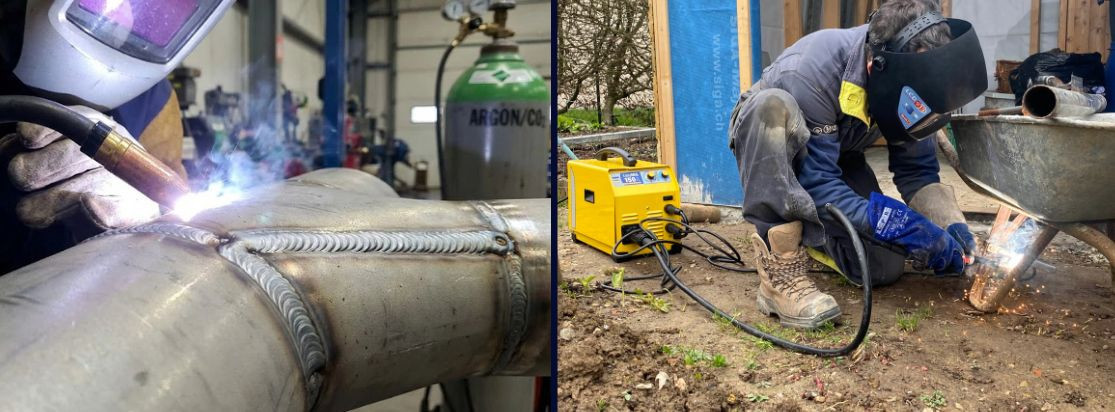
It is possible to weld without gas by using a welding machine compatible with self-shielded flux-cored wire. Whereas conventional MIG/MAG welding relies on an Argon or CO₂ cylinder to protect the arc, flux-cored wire provides its own shielding system.
The wire consists of a metal sheath surrounding a core filled with chemical flux. During melting, this flux generates a protective gas shield and a solid slag layer that isolate the weld pool from atmospheric contamination. This is the ultimate "No Gas" solution, ideal for complete mobility and welding in demanding conditions such as wind or difficult-to-access areas.
Key Takeaways
- Logistical independence: Complete elimination of the gas cylinder, flow regulator, and associated leak risks.
- Wind resistance: Stable protection even in winds of up to 50 km/h, where MIG shielding gas would be blown away almost immediately.
- Specific polarity: Negative polarity (DC-) at the torch is required for most self-shielded flux-cored wires.
- Higher productivity: Higher deposition rates, reaching up to 2.7 kg/h with NR-233 wire, compared with around 1.7 kg/h for conventional stick electrodes.
- Post-weld cleaning: Slag and spatter are common and require thorough brushing after each pass.
How Self-Shielded Flux-Cored Welding Works and Why It Matters
Switching to self-shielded flux-cored wire is often driven by industrial productivity requirements. By eliminating frequent stops for electrode changes or gas cylinder handling, the effective duty cycle can increase from 15–35% with Stick welding to nearly 50–60% with Innershield®.
Understanding Self-Shielded Flux-Cored Wire Technology
The wire has a complex structure: a steel strip is formed into a "U" shape, filled with flux, and then closed. The flux does more than simply protect the arc; it deoxidizes the metal, stabilizes the arc, and allows welding on surfaces with mill scale or light oxidation. This technology simplifies the welding setup and can provide much deeper root penetration than conventional MIG welding.
Advantages in Real-World Conditions: Wind and Mobility
On site, wind is one of the main challenges for MIG/MAG welding. Technical data from Lincoln Electric indicates that Innershield® can maintain its mechanical properties and help prevent porosity in winds of up to 50 km/h without requiring the welding area to be screened off. The technology also allows the use of a long contact tip-to-work distance (CTWD), making it easier to reach the bottom of narrow weld preparations and grooves.
Technical Setup and Welding Machine Settings
Accurate settings are essential for reducing spatter and producing a sound weld.
The Golden Rule of Polarity (DC-)
Self-shielded flux-cored wire is generally used with DC electrode negative (DCEN) polarity.
- Technical benefit: With DCEN, the torch is connected to the negative terminal. This concentrates a greater proportion of the heat at the end of the wire rather than on the workpiece. This heat distribution promotes rapid melting of the flux and wire, increasing the deposition rate while reducing the risk of burn-through on thinner sections.
Settings and Equipment Selection
Wire diameter directly affects penetration and wire-feed speed. For trade work and heavy-duty DIY applications, diameters from 0.9 mm to 1.1 mm are commonly used.
- Wire-feed speed: It must be sufficiently high to maintain stable arc transfer.
- Recommended equipment: A welding machine such as the GYS SMARTMIG 162 is particularly suitable because its polarity can be reversed quickly and easily using the front-panel connections, allowing the operator to switch between gas-shielded and "No Gas" welding.
Metal Compatibility and Process Limitations
Steel, Stainless Steel and the Risks of Welding Galvanized Metal
Self-shielded flux-cored wire performs particularly well on mild steel, but strict precautions are required depending on the material being welded:
- Galvanized steel: Flux-cored wire is highly effective at welding through zinc-coated surfaces. WARNING: Welding galvanized steel releases zinc fumes that can cause "Metal Fume Fever". Local exhaust ventilation and appropriate respiratory protection are essential.
- Thickness: For general-purpose welding, NR-211-MP is a common reference wire, but it is limited to a maximum thickness of 12 mm. For thicker sections or more demanding out-of-position welds, NR-233 is generally preferred.
- Limitations on thin sheet metal: Below 2 mm (14 gauge), the process becomes more difficult to control. For thicknesses from 0.5 mm to 2 mm, MIG welding in Short-Circuit Transfer (SCT) mode generally provides better control and helps reduce distortion and burn-through.
Comparison: Self-Shielded Flux-Cored Wire vs MIG/MAG with Shielding Gas
| Criterion | Flux-Cored Wire (Innershield) | MIG/MAG (Gas-Shielded) |
|---|---|---|
| Outdoor use | Excellent (winds up to 50 km/h) | Very difficult (max. 5 to 10 km/h) |
| Deposition rate | High (~2.7 kg/h with Supershield 11 Flux-Cored Wire ) | Moderate (~1.5 to 2 kg/h) |
| Operating cost | Reduced by 40 to 70% thanks to time savings | High (gas cylinder rental + shielding gas) |
| Finish | Slag removal required, with some spatter | Very clean, minimal post-weld finishing |
| Accessibility | Long CTWD, suitable for narrow grooves | Limited by the shielding gas nozzle |
Conclusion
Gasless welding is the preferred method for field maintenance, outdoor steel construction, and rapid repair work. Its high productivity and resistance to wind make it a highly effective alternative when shielding gas would be difficult or impractical to use.
However, for precision work in the workshop or when welding very thin bodywork sheet metal (< 2 mm), gas-shielded MIG/MAG welding remains the preferred process for achieving a clean, controlled finish. Explore our suitable solutions in our MIG/MAG welding machines category.
Need help choosing the right equipment? Read our MIG Welder Buying Guide.
Sources and reference documents:
- Faster Welding in the Field with Innershield® (Lincoln Electric)
-
Welding Thin Materials: Best Practices for Steel, Stainless Steel, Aluminium and Galvanised Steel