
 Français



_11zon.webp)


_14_11zon.webp)
_6_11zon.webp)



Welding Fume Extraction: Effectively Reducing Risks
- Nada Iddouch
- 04 Nov, 2025
- Welding safety
.jpg)
.jpg)
The emission of welding fumes is a major concern in the industry. Welders are exposed to a complex mixture of metallic particles, toxic gases, and oxides that can affect their health both in the short and long term. Beyond simple respiratory discomfort, these contaminants can cause chronic disorders or worsen existing conditions. Given this reality, effective control and management of emissions are essential to ensure a safe environment and compliance with regulatory requirements.
Innovative Techniques for Welding Fume Extraction
Source Extraction Solutions for Optimal Protection
Prevention begins with the immediate capture of pollutants at their point of formation. Source extraction is therefore the most effective method to prevent fumes from spreading throughout the production site. Various equipment options can efficiently fulfill this role.
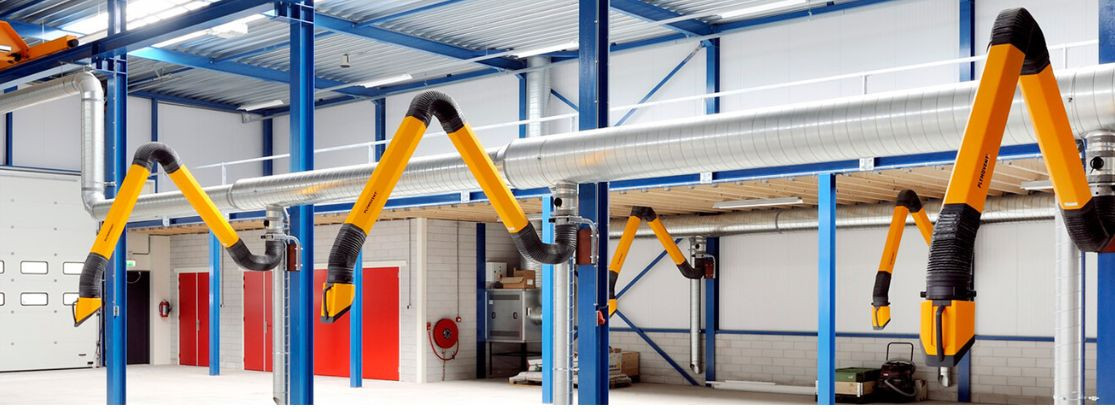
Articulated arms provide great flexibility: their precise positioning enables the capture of emissions at the moment they are generated, drastically reducing their dispersion around the workstation. These devices are ideal for localized tasks or work on large parts requiring frequent adjustment of the extraction point.
Extraction hoods, on the other hand, are best suited for fixed areas or extraction tables specifically designed to hold workpieces during assembly. The vertical capture flow immediately directs particles and gases released during welding toward the filtration system, thus reducing direct exposure for technical staff.
In certain industrial settings—especially when welding takes place in confined or hard-to-reach spaces—mobile extractors equipped with flexible arms prove particularly effective. Their mobility allows quick intervention where a fixed device would be unsuitable: on-site maintenance, occasional repairs, or work inside enclosed compartments can benefit from the same protection as open workshop environments.
Overall efficiency also depends on correct positioning: proper alignment of the extraction device ensures quick removal of pollutants while minimizing unwanted airflows that could reduce system performance. Proper operator training ensures that each workstation benefits fully from the protective potential of these technologies.
Use of Advanced Filtration and Ventilation Systems
Beyond immediate capture, maintaining clean ambient air requires thorough filtration combined with effective ventilation across the production site. Modern technologies integrate multiple filtration stages capable of intercepting both large metallic particles and ultrafine dust often invisible to the naked eye.
HEPA filters or electrostatic systems effectively trap the smallest toxic fractions produced during MIG/MAG or TIG welding. Combined with extraction units powered by high-performance yet quiet fans, they ensure constant air renewal without disturbing acoustic or thermal comfort in the workshop.
Some advanced systems feature dynamic management: sensors continuously analyze pollutant concentrations to automatically adjust the extraction flow rate and intensity based on detected volume. This regulation optimizes both energy consumption and purification efficiency.
To maximize performance, each installation must be sized according to the activity: occasional manual welding or continuous robotic lines, processed air volume, and the number of operators present. A preliminary audit helps determine whether a centralized extraction network is more suitable than several strategically placed autonomous local units.
Finally, combining mechanical filtration with general ventilation—natural or assisted—ensures the absence of stagnant air pockets, even far from active stations, thereby guaranteeing lasting and consistent air quality throughout the industrial environment.
Optimization of Processes and Materials to Limit Emissions
Adoption of Alternative Welding Techniques
Significantly reducing fume production starts with the methodological choices made for each metallurgical operation. Some techniques naturally produce fewer harmful emissions while maintaining the mechanical strength and performance required by industrial specifications.
MIG brazing holds a special position in this regard: similar to traditional welding, it requires less thermal energy due to controlled local fusion between metals joined by a specific filler material. The result is reduced gas production at the molten pool compared to conventional MIG/MAG welding, while maintaining equivalent structural strength. This method is especially valued in the automotive industry, where lightweight structures must meet high safety standards.
Resistance welding is also an effective way to reduce particulate generation. The electric current applied between two plates causes them to bond without visible flame or arc, thus preventing the formation of dense fumes. This process is ideal in shipbuilding or rail construction, where rapid spot welding replaces traditional continuous weld seams, mechanically reducing the total amount of fumes emitted in multi-weld projects.
Some automated technologies, such as hot-wire TIG under inert gas, electron beam welding, or submerged arc welding, offer scalable industrial alternatives that not only drastically cut emissions but also improve quality traceability—an essential factor in aerospace and petrochemical sectors.
By systematically adapting the welding method to the specific application—material thickness, mechanical constraints, production rate, or repetitiveness—it becomes possible to optimize productivity while sustainably improving overall health conditions in the workshop.
Choice of Efficient Materials and Manufacturing Processes
The strategy to reduce intensive welding use also involves upstream reflection, beginning at the product design or industrial process planning stage. Reducing the weight of the final component decreases both energy needs and the total number of passes required, thereby limiting the overall volume of pollutant fumes produced.
Using thinner materials often enables equivalent assemblies while demanding less machine power. Each millimeter reduction in thickness proportionally decreases the heat input, thus reducing the vaporization of metallic components potentially inhalable by operators near active workstations.
Let’s talk about your project
An industry expert will respond within 24 business hours.
Welding fume extraction is crucial to protect welders’ health, as it reduces exposure to metallic particles and toxic gases that can cause respiratory issues and other long-term health problems.
Innovative techniques include source extraction using articulated arms, extraction hoods, and mobile extractors. These systems capture fumes directly at their source, preventing their spread in the workspace.
Advanced filtration systems use HEPA filters and electrostatic devices to capture fine and toxic particles. They are often paired with efficient ventilation to maintain clean and healthy ambient air.
Articulated arms offer great flexibility and precise positioning, allowing fumes to be captured as soon as they are emitted. This minimizes their dispersion around the workstation and effectively protects operators.
Mobile extractors are ideal for confined or hard-to-reach areas. Their mobility enables quick and efficient intervention where fixed systems cannot be used.
Welding processes can be optimized by adopting alternative techniques such as MIG brazing or resistance welding, which produce fewer fumes while maintaining the required strength and quality.
Choosing thinner materials or alternative fastening methods such as bolting or riveting can reduce the need for welding, thereby decreasing fume emissions.