
 Français



_11zon.webp)


_14_11zon.webp)
_6_11zon.webp)



Optical Evaluations: Choosing Your Welding Helmet
- Nada Iddouch
- 09 Dec, 2025
- Welding safety
.jpg)
Protecting welders’ vision from intense light, radiation and sparks is an absolute priority in industry. Beyond simply wearing a helmet, the optical quality of the filter plays a decisive role both for safety and for the precision of technical movements. Extreme conditions and awkward postures require careful selection: every detail matters to ensure visual comfort, endurance and performance. Standardized optical assessments under EN 379 thus provide an essential benchmark for choosing a welding helmet truly suited to each professional context.
Importance of optical assessments when choosing a welding helmet
Understanding optical ratings for maximum protection
The EN 379 standard establishes a rigorous evaluation system to measure the optical performance of welding filters. This framework ensures that each filter meets stringent requirements for visual clarity and safety. In contrast to common markings — darkness level, manufacturer references, general compliance — the optical rating delivers more complete information: it directly reflects the actual level of protection afforded to the eyes.
An effective auto-darkening filter must not only switch quickly from a light to a dark state. Its true value lies in its ability to preserve a clear vision, without distortion or visual discomfort, even under an intense electric arc. The ratings are grouped into a four-digit code (e.g., 1/1/1/1), which objectively reflects the overall quality of the filter according to several complementary parameters.
Key components of the optical ratings
The analysis of those ratings is based on four fundamental criteria — each directly influencing visual comfort and safety during welding:
– Optical class: Measures the fidelity of the perceived image. A class 1 ensures distortion-free vision — no straight lines appear bent or blurred — facilitating precise control of the molten pool and weld beads.
– Light diffusion: This criterion evaluates the filter’s ability to block or limit stray light that may scatter within its structure. Controlled diffusion (class 1) improves sharpness and contrast while reducing eye fatigue.
– Uniformity: Ensures that the tint remains even across the entire surface when looking perpendicularly through the filter. High uniformity eliminates local brightness variations that could impair view of the weld joint.
– Angular dependence: Essential parameter, it measures the stability of the darkening level when the gaze shifts away from the central axis. An excellent score ensures consistent protection even when working off-axis — a typical case for overhead welding or confined spaces.
For each of these criteria, ratings range from 1 to 3: 1 representing excellence, 3 the minimal acceptable limit. Only helmets achieving an optimal score across all parameters simultaneously offer maximum clarity, reliable protection against harmful radiation, and prolonged comfort — even during complex operations.
| Category | Class 1 | Class 2 | Class 3 |
|---|---|---|---|
| Optical clarity | Very sharp vision | Slight distortion | Marked distortion |
| Light diffusion | Optimal contrast | Light blur | Significant loss |
| Homogeneity | Perfect uniformity | Low variation | Uneven areas |
| Angular dependence | Stable shade | Moderate variability | High instability |
Selecting the ideal welding helmet based on working conditions
The importance of angular dependence for welders
When the job requires uncomfortable positions — arm extended above the body, side access to a pipe, or work inside a narrow compartment — it often becomes impossible to perfectly align the eyes with the electric arc. In these frequent situations where only an angled view allows proper observation of the work area, even the slightest fluctuation in the darkening level can significantly disrupt the technical gesture.
Filters offering excellent angular independence (Class 1) ensure that, regardless of the relative orientation between eye, filter and arc, neither shade nor intensity varies noticeably across the visible surface. With each lateral eye movement or slight helmet shift, no “venetian blind effect” appears: no localized brightening or darkening that could hide emerging defects or irregularities on the weld joint.
This perfectly uniform behavior protects against two major risks:
- Eye fatigue caused by constant adjustments to sudden variations;
- Loss of concentration, which can lead to technical errors or incidents.
In summary: a filter rated Class 1 for angular dependence is essential whenever your work regularly involves difficult welds or confined environments.
Selecting the right filter for your specific needs
Given the wide range of situations — alternating between comfortable workshop tasks and on-site operations — having the right filter directly impacts your productivity and daily comfort.
For maximum stability at any angle, certain specialized models such as the Optrel e684 or Panoramaxx Quattro combine all the qualities sought by operators facing extreme spatial constraints: pipework, overhead positions, upside-down work, hard-to-reach areas… Their priority is to deliver flawless consistency at all angles to eliminate any distracting variation during off-axis welding.
Examples:
– Optrel e684
– Panoramaxx Quattro
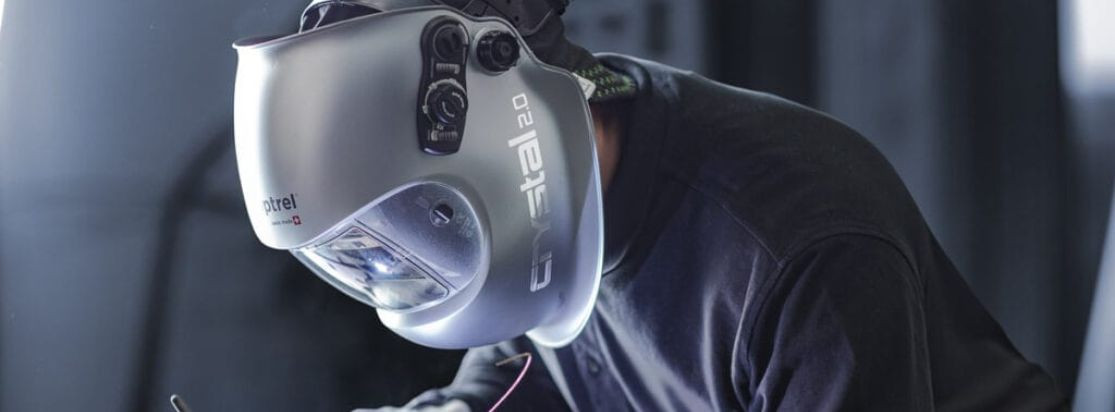
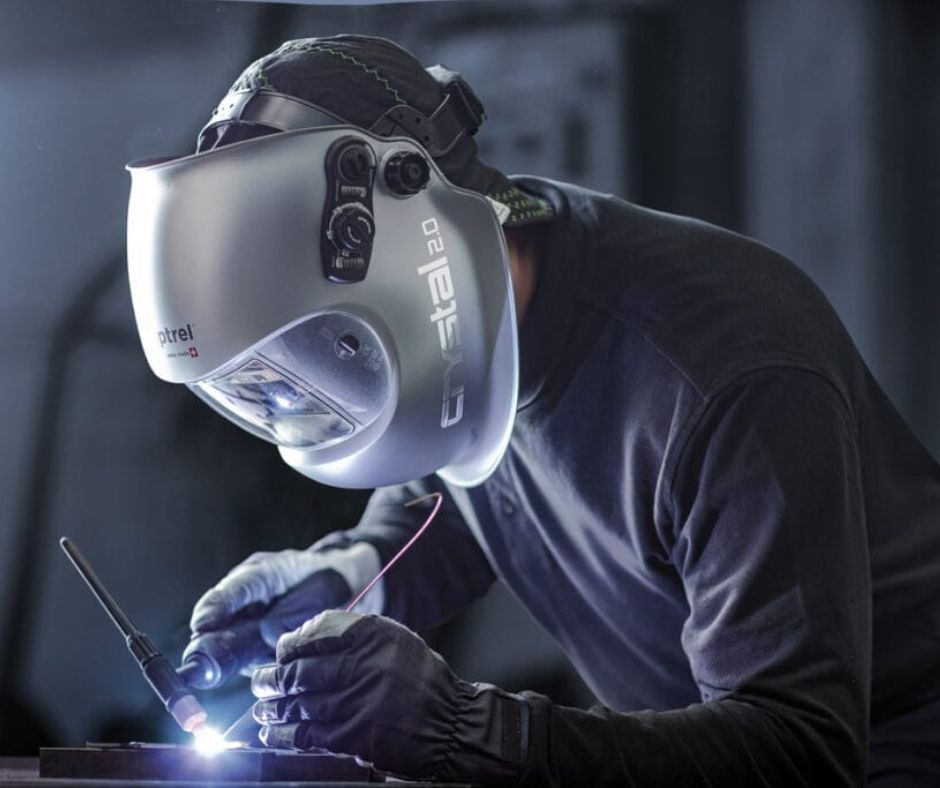
For extreme clarity and faithful color perception, variants such as Crystal 2.0 or Panoramaxx CLT stand out thanks to their highly accurate color rendering and superior light transmission in light mode. They are ideal when visual inspection of metallurgical shades or finishing details is part of your routine, without removing the helmet or switching to a transparent visor.
Examples:
– Crystal 2.0
– Panoramaxx CLT
For a versatile balance, intermediate models are available. The 2.5 Lens filter offered in the Sphere, Panoramaxx and Helix ranges combines an extremely bright light state (Shade Level 2.5), good uniformity, and natural color rendering. This solution appeals to users who alternate between long, precise tasks and quick interventions requiring immediate adaptation to light changes.
Quick comparative summary:
| Model | Priority | Typical use |
|---|---|---|
| e684 / Panoramaxx Quattro | Consistency from all angles | Overhead welding, complex postures, confined spaces |
| Crystal 2.0 / Panoramaxx CLT | Clarity & accurate color rendering | Precise control, finishing, metallurgical inspection |
| Sphere / Panoramaxx / Helix 2.5 | General balance | Alternating long tasks and varied work conditions |
Conclusion & recommended action
A clear understanding of the optical ratings defined by EN 379 not only enhances the safety of your welding practices but also improves your day-to-day comfort and efficiency in the demanding realities of modern industrial welding.
To determine exactly which model is best suited to your needs — frequent off-axis positioning? High requirements for accurate color perception? Need for total versatility? — request a personalized recommendation or a detailed quote tailored to your professional constraints from a recognized specialist in high-performance welding PPE.
Let’s talk about your project
An industry expert will respond within 24 business hours.
The EN 379 standard defines a rigorous evaluation system used to measure the optical performance of welding helmet filters. It ensures that each filter meets strict requirements for visual clarity and safety, guaranteeing optimal eye protection for welders.
Optical ratings consist of four fundamental parameters: optical class, light diffusion, homogeneity, and angular dependence. Each of these criteria directly influences visual comfort and protection during welding.
Angular dependence is crucial because it ensures that the darkening level remains consistent even when the eye moves slightly away from the central axis. This is essential for welders working in uncomfortable positions or confined spaces, ensuring constant visual protection.
A high-performance auto-darkening filter does more than switch quickly between light and dark states. It maintains clear vision while eliminating disturbing distortions, which is critical when working under an intense electric arc.
Models such as the Optrel e684 and Panoramaxx Quattro are recommended for welders who work in complex positions or confined spaces. They offer flawless consistency from all viewing angles.
To choose the right welding helmet, it is important to consider your specific working conditions, such as the need to work off-axis or to have highly accurate color perception. Models like the Crystal 2.0 or Panoramaxx CLT are ideal for precise color rendering.
A filter with an optical class of 1 provides very sharp vision with no noticeable distortion, making it easier to precisely observe the weld pool or bead. This improves accuracy and reduces eye fatigue.