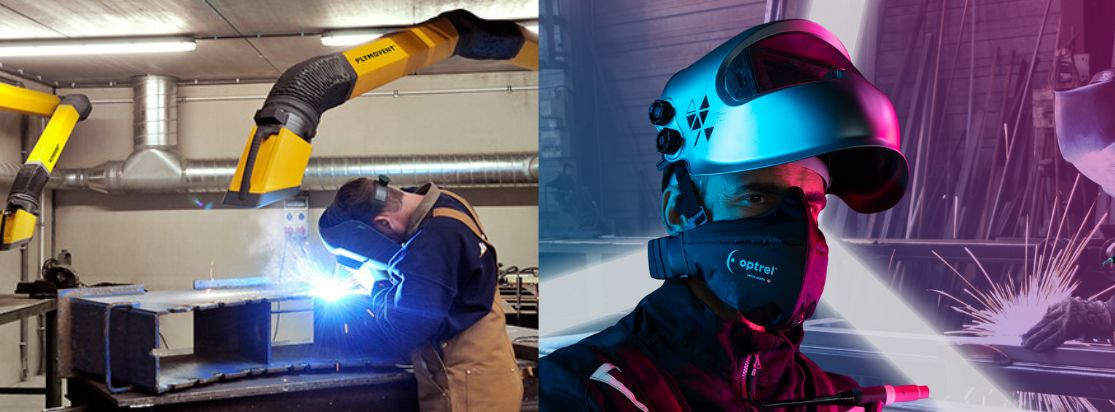
Welding fume extraction is a major concern for the health and safety of workers in the metalworking industry. The fumes generated during welding operations contain many harmful substances that can have both short- and long-term adverse health effects. This article explores various methods and solutions to effectively prevent and control exposure to welding fumes in the workplace.
I. Understanding the Risks of Welding Fumes
Welding fumes are made up of microscopic particles and gases that are released when metals and their coatings melt. These fumes contain various pollutants such as metal oxides, toxic gases, and volatile organic compounds. Prolonged exposure can lead to respiratory problems, eye and skin irritation, and more severe conditions like lung cancer.
The nature and amount of fumes produced depend on several factors:
- The welding process used
- The materials and coatings being welded
- Welding parameters (amperage, voltage, etc.)
- Duration of exposure
It is therefore essential to implement a comprehensive strategy to minimize fume production at the source and limit worker exposure.
II. Preventing Fume Generation at the Source
The first step in reducing risk is to limit fume production from the outset. Several approaches can be considered:
1. Favor Alternatives to Manual Welding
Where possible, manual welding should be replaced by alternative methods that generate fewer fumes:
- Robotic welding offers better control over parameters and reduces direct operator exposure.
- Mechanical assembly (bolting, riveting) or bonding may be used instead of welding in some applications.
While not always applicable, these alternatives should be evaluated during part and process design.
2. Optimize Welding Processes and Parameters
The choice of welding process and optimization of parameters directly impact the amount of fumes generated:
- Processes such as TIG or plasma welding produce fewer fumes than shielded metal arc welding.
- Adjusting voltage, amperage, and welding speed helps reduce fume formation while maintaining weld quality.
- Using low-fume flux-cored wires can also help reduce emissions.
Proper training of welders on these technical aspects is essential to achieve the best results.
3. Select Suitable Materials and Consumables
The selection of base and filler materials is also important:
- Avoid, where possible, metals with coatings (paint, oil) that decompose during welding.
- Choose electrodes and filler wires with low levels of toxic elements like chromium or nickel.
- Use inert shielding gases instead of CO₂-containing mixtures that promote fume formation.
A prior analysis of material composition helps identify potential risks and adapt prevention measures accordingly.
III. Effectively Capturing and Extracting Fumes
Despite preventive efforts, fume generation is often unavoidable. Effective systems must therefore be installed to capture fumes as close as possible to their emission source.
1. Source Extraction Technologies
Several technical solutions exist to capture fumes directly at the welding point:
- Fume extraction torches incorporate a suction system directly into the welding tool, ideal for mobile work.
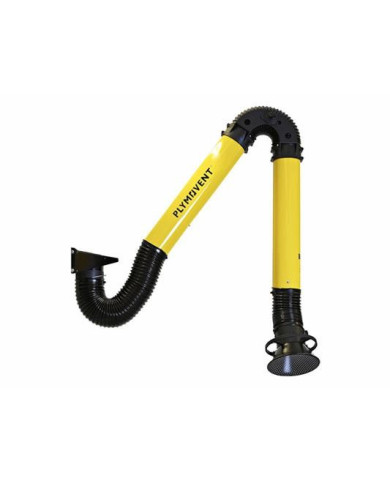
- Articulated arms allow the suction hood to be positioned close to the work area, suitable for fixed stations.
- Downdraft tables are ideal for small parts, capturing fumes from beneath the work surface.
- Overhead hoods suit large parts or extended work zones, capturing rising fumes naturally.
The choice of technology depends on workstation layout, part type, and mobility requirements.
2. Proper Design and Installation of Extraction Systems
An effective extraction system must be properly sized and installed:
- Suction flow must be sufficient to capture all generated fumes.
- Capture velocity at the source should be at least 0.5 m/s.
- Ducts should maintain a transport speed between 10 and 20 m/s.
- Extraction should occur as close as possible to the source—ideally within 30 cm.
A thorough technical assessment is required to design an optimal system tailored to each situation. Consulting specialized professionals is often recommended for optimal performance.
3. Filtering and Releasing Extracted Fumes
Once captured, fumes must be filtered before being released:
- Mechanical filters (bag or cartridge types) effectively retain solid particles.
- Activated carbon filters capture certain gases and vapors.
- Advanced systems like electrostatic precipitators may be used for specific applications.
Filter system selection depends on the type of pollutants present. An analysis of fume composition is recommended to choose the most suitable technology.
IV. Complement with Proper General Ventilation
Source extraction should be complemented by effective general ventilation to dilute and remove residual fumes:
- The workshop should have sufficient air renewal (typically 5 to 10 air changes per hour).
- Air intake and exhaust placement should create a flow from clean to polluted areas.
- Fresh air should be preheated in winter to avoid cold drafts.
- Partial recirculation of filtered air may be considered to reduce energy costs.
The general ventilation system must be designed considering building layout, pollution sources, and process constraints.
V. Organize Work to Minimize Exposure
Beyond technical solutions, work organization plays an important role in reducing fume exposure:
- Isolate welding operations in dedicated, enclosed zones where possible.
- Use screens or curtains to limit fume dispersion.
- Train welders to adopt working positions that minimize direct fume inhalation.
- Alternate tasks to reduce individual exposure duration.
- Restrict access to welding areas to essential personnel only.
These organizational measures effectively complement technical solutions in risk mitigation.
VI. The Role of Personal Protective Equipment
Although collective measures should take priority, personal protective equipment (PPE) may be necessary in some cases:
- Powered air-purifying respirators provide effective respiratory protection and enhance welder comfort.
- Welding helmets with integrated filtration combine respiratory and eye protection.
- Protective clothing limits skin contact with particles.
PPE selection should be based on residual risk assessment after implementing other preventive measures. Training in correct PPE usage is essential.
Conclusion: A Global and Evolving Approach
Managing welding fumes requires a comprehensive approach combining source prevention, fume capture, ventilation, and individual protection. The strategy must be regularly assessed and updated as techniques and risk knowledge evolve.
A participative approach involving management, supervisors, and operators helps identify the best solutions and encourages their adoption. Investing in high-performance equipment and continuous staff training are key to ensuring a healthy and safe work environment.
By adopting such an approach, companies can not only comply with regulations but also improve working conditions, productivity, and their corporate image. Worker health and workplace quality are key assets for attracting and retaining qualified labor in the welding sector.

 Français



_11zon.webp)


_14_11zon.webp)
_6_11zon.webp)