
 Français



_11zon.webp)


_14_11zon.webp)
_6_11zon.webp)



Welding Screen Setup: Enhance Safety with Ease
- Nada Iddouch
- 05 Feb, 2026
- Welding safety
.jpg)
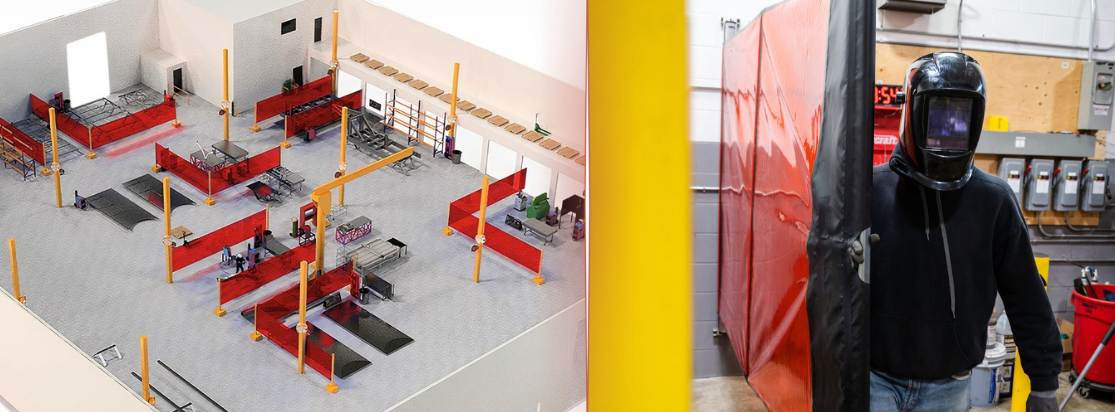
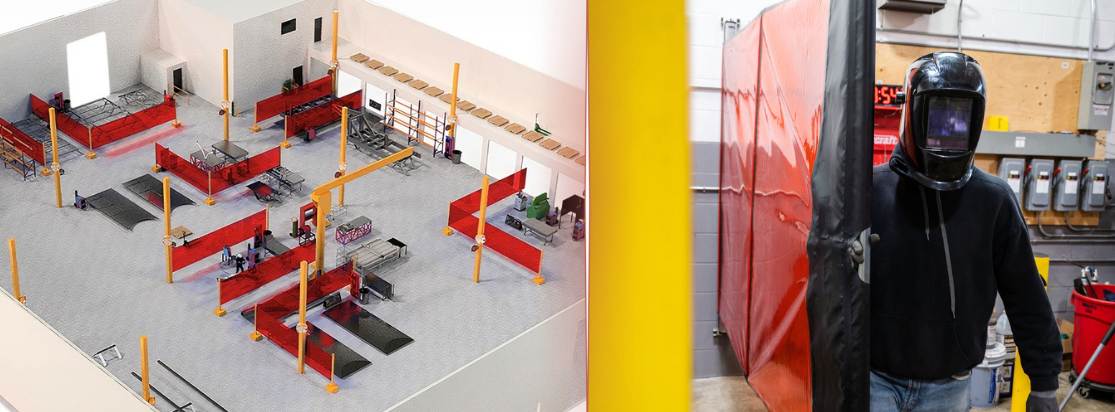
In welding environments, safety is paramount in the face of risks from sparks, splatter, and heat. A properly installed retractable welding screen provides effective protection while remaining practical to use. Following each installation step not only ensures operator safety but also extends the lifespan of the equipment.
Ensuring correct screen orientation
Before any fixing, it is essential to identify the correct orientation for installing the screen. A simple oversight at this stage can lead to malfunctions and reduce its protective effectiveness.
To identify the top and bottom of the retractable panel, locate the arrow sticker on the winding tube: this arrow always indicates the upper side. Another visual cue is found on the compliance label attached to the curtain—if it appears upside down once installation is complete, this means the screen has been mounted incorrectly.
Installing a screen upside down often causes difficulties during retraction or extension. Protection against debris is reduced, and achieving even tension during deployment becomes more difficult. Taking a few moments to check these elements prevents later time loss and ensures optimal operation from first use.
Measuring accurately for a flawless installation
Careful measurement before fixing determines the future reliability of the entire system. Installing a screen too high or too low causes issues such as visible sagging, poor tension, or interference during movement.
To avoid these defects, accurately measure the height at which the main tube will be fixed to its support. Using a level ensures that everything remains perfectly straight along the entire operating length. Poor alignment quickly creates weak points where the screen may bend or leave unprotected gaps.
Precise positioning promotes smooth deployment without snags or excessive friction against the floor or nearby structures. This fundamental step ensures each retraction occurs without strain or premature wear on the fixings.
Advanced techniques for efficient installation of a retractable welding screen
Certain methods greatly simplify fixing and help achieve a solid result with less effort. Following these best practices reduces the risk of error while optimizing the overall stability of the protective system.
Simplifying installation by positioning the post horizontally
Rather than trying to keep the post vertical throughout installation (which often requires two people), it is much easier to place the support on the ground in a horizontal position. This setup allows full control by a single person—no colleague is needed to stabilize the roller or hold components during assembly.
The fact that some models allow easy removal of the main post further simplifies the process: the post can be laid flat on the ground, making it easy to securely attach the housing containing the retractable screen and its accessories (hooks, clamps, etc.).
Once all elements are firmly attached in the correct positions, simply return the assembly to a vertical position and reinstall the mobile base under the post if required. This method significantly reduces risks associated with awkward handling and also limits fatigue caused by prolonged overhead work.
Choosing the deployment direction for optimal coverage
The direction in which the screen is pulled directly affects its ability to properly protect all sensitive areas around the welding station. Depending on your workshop or industrial space, you may prefer deployment to the left, to the right, or at a specific angle adapted to internal logistical flows.
Before permanently attaching anything to the main support, carefully consider the desired direction for easily deploying the protective surface where it will be most useful: frequent operator traffic? Nearby machines requiring temporary separation? This strategic choice simplifies subsequent steps (notably positioning the J-hooks), as each fixed point naturally aligns with the ideal axis relative to existing spatial constraints.
Correct positioning at this stage also allows daily users (welders and technicians alike) to fully utilize the available width without needing to frequently reposition equipment during successive operations.
Enhancing strength and longevity with appropriate techniques
Overall performance also depends on accessory selection and attention to mechanical details at every key stage. Neglecting these elements can quickly lead to excessive play or premature sagging, sometimes within the first few weeks of use.
Selecting the right fasteners: Tek screws and Tapcons
The recommended approach is to prioritize self-drilling screws (Tek type). Their aggressive threading enables immediate and reliable penetration into most metal supports used in industrial or workshop structures. This type of fastening effectively limits the risk of gradual loosening caused by repeated vibrations from daily handling, ensuring long-term stability without frequent readjustment.
For direct anchoring into masonry or concrete, it is preferable to use specific Tapcon-type fasteners. Designed to withstand dynamic loads, they provide optimal holding strength in demanding environments, particularly near workshops equipped with heavy machinery or in high-traffic areas subject to constant mechanical stress.
Combining a suitable load-bearing material with a reliable mechanical fastening solution is therefore a true guarantee of safety. It helps prevent any unintended movement that could compromise the expected level of protection around sensitive areas, especially during localized thermal operations such as MIG, MAG, or TIG welding.
Precisely aligning J-hooks on the adjacent support
Once the main screen is securely fixed to the first vertical post, it is essential to check how it meets or overlaps the opposite or lateral support, depending on the chosen configuration. The goal is to accurately anticipate the placement of the J-hooks, which are used to temporarily lock the welding curtain or keep it perfectly tensioned horizontally when fully deployed opposite the main housing (motorized or not, depending on the model installed in a workshop, on-site, or outdoors).
Consistent use of a spirit level, alternately positioned above and below the rail or curtain, is essential to ensure perfectly straight alignment. Even slight misalignment can cause visible slack in the curtain, resulting in unsightly waves and, more importantly, reduced effectiveness in protecting against spark splatter and stray light radiation outside the work area.
To accurately determine drilling and fixing points for each hook—whether installed singly or in multiples depending on curtain width and the intended multi-station configuration—extend the curtain to its maximum reach. Then mark precise reference points using a pencil or marker before proceeding with final drilling and fastening, in accordance with the manufacturer’s recommendations and technical specifications. This method ensures a durable, scalable installation perfectly suited to current or future industrial constraints.
Ensuring long-term stability with a properly weighted mobile base
Some models are available with an optional mobile base, allowing quick and easy movement between different sensitive areas as assembly chains, continuous or semi-continuous production lines, and flexible, evolving industrial environments change—regardless of company size or industry sector.
To guarantee optimal stability during intensive, long-term use—including accidental impacts, abrupt handling, or unintentional contact caused by passing wheeled equipment (hoists, pallet trucks, dollies, forklifts, etc.)—it is essential to properly ballast the compartment designed for this purpose. The choice of additional weight must be adapted to the nature of operations and the specific constraints of the working environment to ensure durable and reliable safety under all circumstances.
| Ballast material | Main advantages |
|---|---|
| Concrete | High density; readily available everywhere |
| Metal scrap | Internal reuse; cost-effective and eco-friendly |
| Sand | Easy to install; quantity easily adjustable |
Always ensure that the total load remains compatible with the structural tolerance specified in the manufacturer’s documentation and that it complies with the safety standards applicable at the installation site, whether for continuous, intermittent, alternating, variable, seasonal, occasional, or exceptional use.
A meticulous installation of the ROLLTect retractable welding screen is essential to fully benefit from its effectiveness and to guarantee a safe and efficient working environment. By taking the time to measure accurately, align components correctly, and securely fasten the screen—while also considering key parameters such as the direction of pull or the stability of a mobile base—you ensure smooth operation and optimal protection.
The use of appropriate tools and fasteners, such as Tek self-drilling screws, combined with adherence to best installation practices, simplifies implementation and enhances overall durability, helping to extend the service life of the system. When properly installed, the ROLLTect system not only improves safety but also optimizes the organization and efficiency of your welding operations by providing reliable, long-lasting protection. For any additional information, please do not hesitate to contact us.
Let’s talk about your project
An industry expert will respond within 24 business hours.
A retractable welding screen is a protective device used in welding environments to shield against sparks, spatter, and heat. It is designed to be easily deployed and retracted as needed.
Proper orientation ensures the screen’s protective effectiveness and correct operation. An incorrectly oriented screen can cause malfunctions and reduce protection against debris.
It is essential to accurately measure the height at which the main tube should be fixed. Using a level ensures the installation is straight, preventing issues such as sagging or poor tension.
Positioning the post horizontally on the ground makes installation easier for a single person. This allows full control without needing a colleague to stabilize the roller or hold components.
The deployment direction should be chosen based on the layout of the workshop or industrial space. This ensures optimal coverage of sensitive areas around the welding station.
For metal structures, self-drilling screws (Tek screws) are recommended. For masonry, Tapcon anchors are ideal to ensure long-term stability.
Using a weighted mobile base, with materials such as concrete, metal scrap, or sand, ensures excellent stability, even in the event of accidental impacts or unintentional handling.