Welding operations generate fumes that are potentially dangerous to workers' health. Effective extraction of these fumes is essential to ensure a healthy and safe work environment. Among the different methods available, source extraction stands out as the solution most recommended by experts. This article explores in detail the advantages of this technique and its importance in protecting welders.
1. Why is source extraction so important?
Source extraction involves capturing welding fumes directly at their point of emission, before they disperse into the ambient air. This method has many advantages over general workshop ventilation:
- Maximum efficiency: By capturing fumes as close as possible to their source, up to 90% of pollutants are eliminated before they reach the welder's respiratory tract. This significantly reduces exposure to harmful substances.
- Energy savings: Localized extraction requires treating a much smaller volume of air than general ventilation. This translates into substantial savings in terms of energy consumption.
- Flexibility: Source extraction systems are generally mobile and easily adapt to different workstations. They thus offer great flexibility of use.
- Environmental protection: By effectively filtering fumes at the source, the dispersion of pollutants into the atmosphere is limited, thus helping to preserve the environment.
- Regulatory compliance: Source extraction makes it easier to comply with current standards regarding air quality in the workplace.
2. Different types of source extraction systems
There are several technical solutions for implementing effective source extraction:
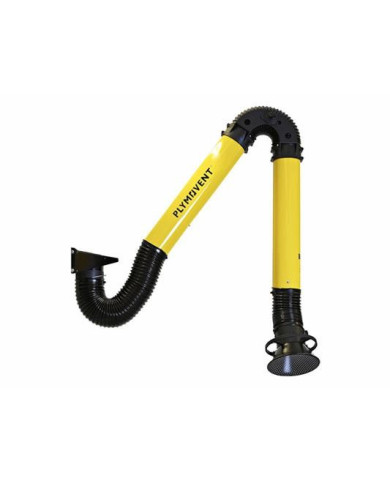
- Articulated arms:These flexible devices are positioned as close as possible to the welding area. They are particularly suitable for mobile workstations or large parts.
- Downdraft tables: Ideal for welding small parts, they integrate an extraction system into the work surface. The fumes are thus captured downwards, away from the welder's respiratory tract.
- Fume extraction torches: These welding torches directly integrate an extraction system. They offer excellent fume capture but may be heavier and less maneuverable than conventional torches.
- Suspended hoods: For fixed stations handling bulky parts, hoods suspended above the work area allow for effective fume extraction.
- Welding booths: These confined and ventilated spaces offer maximum protection for intensive welding operations or on particularly emissive materials.
3. Implementing a source extraction system
Installing a source extraction system requires a thorough analysis of the specific needs and constraints of each workshop. Here are the main steps to follow:
- Risk assessment: Identify the types of welding practiced, materials used, and production volumes to determine fume emission levels.
- System selection: Choose the most suitable extraction solution based on workstations, required mobility, and space constraints.
- Sizing: Calculate the necessary extraction flow rates to ensure effective fume capture, taking into account manufacturers' recommendations and current standards.
- Installation: Set up the system ensuring its ergonomics and ease of use to promote its adoption by operators.
- Training: Train welders in the correct use of the extraction system and raise awareness of the importance of its systematic use.
- Maintenance: Establish a regular maintenance program to ensure the system's performance over time (filter cleaning, flow rate checks, etc.).
4. Key success factors for effective extraction
To fully benefit from the advantages of source extraction, certain essential factors should be taken into account:
- Optimal positioning: The capture device should be placed as close as possible to the emission source, ideally less than 30 cm from the welding point.
- Adapted extraction flow: The airflow must be sufficient to effectively capture fumes without disturbing the fusion bath or gas protection.
- Ease of use: The system must be simple to handle and adjust to encourage its systematic use by operators.
- Efficient filtration: Choosing filters adapted to the types of pollutants generated is essential to ensure the quality of the discharged air.
- Process integration: Extraction must integrate harmoniously into the production flow without hindering operator movements or part passage.
5. Long-term benefits of source extraction
Investing in a high-performance source extraction system brings many long-term advantages:
- Worker health: By drastically reducing exposure to harmful fumes, the risks of occupational diseases related to welding (respiratory disorders, cancers, etc.) are decreased.
- Increased productivity: A healthier work environment promotes operator well-being and limits absenteeism, thus contributing to better productivity.
- Company image: Implementing effective solutions to protect employee health enhances the company's attractiveness to customers and potential collaborators.
- Cost reduction: In the long term, savings on health costs, work stoppages, and possible sanctions for non-compliance largely offset the initial investment.
- Continuous improvement: Analysis of data collected by modern extraction systems allows for continuous optimization of welding processes and air quality management.
Source extraction stands out as the most effective method for protecting welders from the dangers associated with welding fumes. By capturing pollutants directly at their point of emission, this technique offers optimal protection while presenting many advantages in terms of energy efficiency and flexibility.
Implementing a suitable source extraction system requires a thorough analysis of the specific needs of each workshop. Particular attention must be paid to equipment selection, sizing, and integration into the production process.
The long-term benefits of effective extraction are considerable, both for worker health and for the company's productivity and image. Investing in a high-performance solution for extracting welding fumes at the source is therefore a wise choice for any company concerned about employee safety and overall performance.

 Français



_11zon.webp)


_14_11zon.webp)
_6_11zon.webp)